The arc goes both ways.
What a newborn and a seventy-eight-year-old have in common, and why we stopped calling it equipment.
What we give a newborn on the first day, and why nobody calls it medical equipment
A newborn cannot survive on its own. Not for an hour.
Everything comes from someone else. Warmth. Food. Movement. The dependency is total. And we don’t hesitate. We build nurseries. We buy monitors and cot rails and high chairs and baby carriers. We wrap the child in scaffolding from the moment it arrives, and we do it with love, without anyone thinking this means something has gone wrong.
No one calls a cot rail medical equipment. No one files insurance paperwork to buy a high chair. These are just what you do for someone who needs support to live.
And then, gradually, you take it away.
The longest withdrawal: how raising a child means working toward your own irrelevance
Raising a child is the systematic removal of scaffolding.
The bicycle you let go of. Every parent knows the moment: you realise they haven’t noticed you let go. The homework you stop checking. The calls that space out, not because you love them less but because they need you less.
Every good parent is working, year by year, toward their own irrelevance. That is the job. Take away the support as the capacity grows, and what you are left with is a person who can stand in their own life.
By their mid-thirties they stand alone. That is the point of all of it.
Most people understand this arc without being told. It is the shape of growing up.
What fewer people sit with is what happens next.
When the scaffolding comes back: a knee brace in Ballygunge, a walker in Gariahat
It does not happen all at once. It happens gradually, and then, one Wednesday night in a Ballygunge flat, suddenly.
A knee that objects on the stairs. Reading glasses on every surface in the house. Nothing dramatic. Just the first quiet signal that something needs adjusting.
Then, over time, something more visible. A brace. A grab bar in the bathroom. A walking stick hooked over the back of every chair at every family dinner. And later, for some, a walker. A wheelchair.
The scaffolding comes back.
Not as failure. As what a full life actually looks like across a full span.
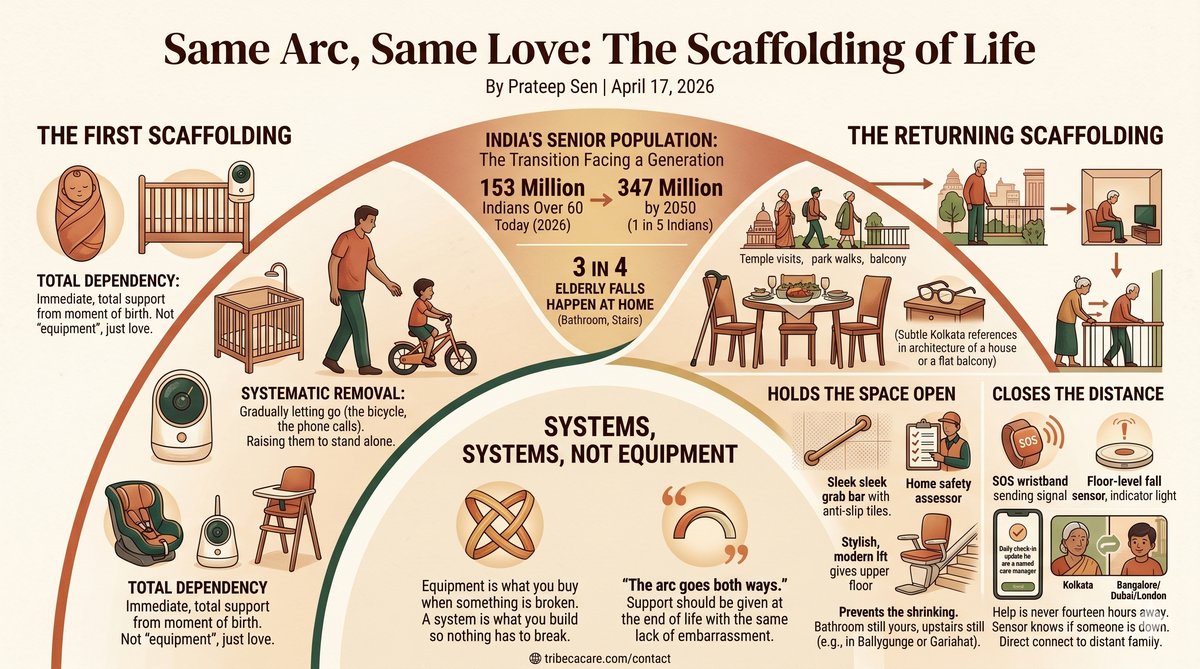
Because when the scaffolding needs to return, we often treat it as a crisis rather than a transition. And it is a transition facing an entire generation. There are 153 million Indians over sixty today. By 2050, there will be 347 million. One in five of us. Three out of four falls among the elderly happen at home, not outside, not in traffic, at home, in the bathroom, on the stairs. One in five who fracture a hip do not survive the year.
Every one of those numbers is someone’s mother on a bathroom floor in South Kolkata at eleven at night, while the nearest child is in Bangalore or Palo Alto trying to get on a flight.
The shrinking nobody notices: when a full life quietly becomes one room and a television
There is a kind of loss that happens before the obvious loss.
It does not announce itself. It happens in the spaces between Sunday phone calls.
The upstairs your father stopped visiting because the stairs felt uncertain. The balcony your mother no longer uses. The morning walk to the park that got shorter and shorter and then just stopped. The Kalighat temple visit that was weekly, then Puja only, then not at all.
The world of a person who was, until recently, living a full life quietly shrinks to one room and a television. The family rarely notices until something breaks. By then the shrinking has been happening for months. Sometimes years.
This is what good scaffolding prevents. Not the fall. The shrinking. The slow, quiet disappearance of a daily life that was, until recently, full.
Two kinds of scaffolding for elderly parents: one holds the space open, the other closes the distance
When we think of scaffolding for elderly parents, we think of physical things. A grab bar next to the commode. Anti-slip tiles in the bathroom. A bed rail that means no one rolls off at three in the morning. A stair lift that gives the upstairs back. A knee brace that keeps the morning walk alive.
These are the things you can see and touch. They hold the body in place.
But there is a second kind of scaffolding now, and for families managing elderly parents in Kolkata from another city or from abroad, it may matter even more. Digital scaffolding.
An SOS device on the wrist. One press and it reaches whoever is on the list: the neighbour, the care manager, the son in Dubai. A fall detection sensor that doesn’t need a camera, doesn’t feel like surveillance, but knows when someone has gone down and sends an alert even if the person cannot call. A simple daily check-in from a care manager, noted and sent as an update to the family, so the Sunday phone call is not the only window into how things actually are.
The digital scaffolding is not about the device. It is about the person on the other end. The care manager who has visited your mother forty-seven times and knows that she skipped her walk today, and that this matters. The update that lands in your inbox in Bangalore at nine in the morning, not because something went wrong, but because you asked to know how she actually is.
The physical scaffolding holds the space open. The grab bar means the bathroom is still yours. The stair lift means the upstairs is still yours.
The digital scaffolding closes the distance. The SOS device means help is never fourteen hours away. The sensor means a fall at eleven at night does not become a morning on the bathroom floor. The daily update means the family in Bangalore or London knows what is real, not just what Ma says is fine.
Both kinds of scaffolding do the same thing: they keep the world from getting smaller.
A grab bar costs a few thousand rupees. An SOS device costs about the same. What they hold in place is worth everything.
The day we stopped calling it Durable Medical Equipment, and what we call it now
We had a business called the DME Center.
Durable Medical Equipment. Grab bars, bed rails, stair lifts, wheelchairs, SOS devices, fall detection sensors. Technically accurate. Every word of it wrong.
I kept watching what the name did to people. Our own team talked about the work as though they were in the business of managing decline. Families came in heavy, reluctant, as though buying a grab bar was signing a piece of paper that said: the good part is over.
That framing treats the returning scaffolding as a medical event. A problem to manage. A set of objects you buy when something has been lost.
We renamed it Tribeca Life Systems.
Life. Systems.
Equipment is what you buy when something is broken. A system is what you build so nothing has to break. A system includes the grab bar and the sensor and the care manager who knows your parent’s name and the update that reaches you every evening and the protocol that kicks in at eleven at night when something goes wrong. That is not a product. That is scaffolding.
Same arc, same love: what a baby monitor and an SOS button have in common
I think about the baby in the cot with the monitor on the nightstand, and the seventy-eight-year-old in the house in Gariahat with the SOS button on her wrist, and I do not see two different problems.
Both need scaffolding. Both deserve it without embarrassment.
We give it to the baby without thinking twice. We buy the baby monitor, the cot rail, the car seat, the high chair. We understand, without anyone having to explain it, that the scaffolding is not the story. The life it holds up is.
We have not yet learned to give it the same way at the other end. The grab bar should feel as natural as the cot rail. The fall sensor should feel as obvious as the baby monitor. The home safety assessment should feel as routine as the paediatrician visit.
That is what Tribeca Life Systems exists to do. Not sell equipment. Not manage decline. Hold the life in place, a little longer, with a little more dignity, in the home where it belongs.
The arc goes both ways. The scaffolding should too.
If you are starting to see the world shrink for someone you love, let us talk about how to hold that space open. You do not have to wait for a fall to build a system. tribecacare.com/contact
