Home based Elder Care Services vs Old Age Home in Kolkata: An Honest Guide for Families
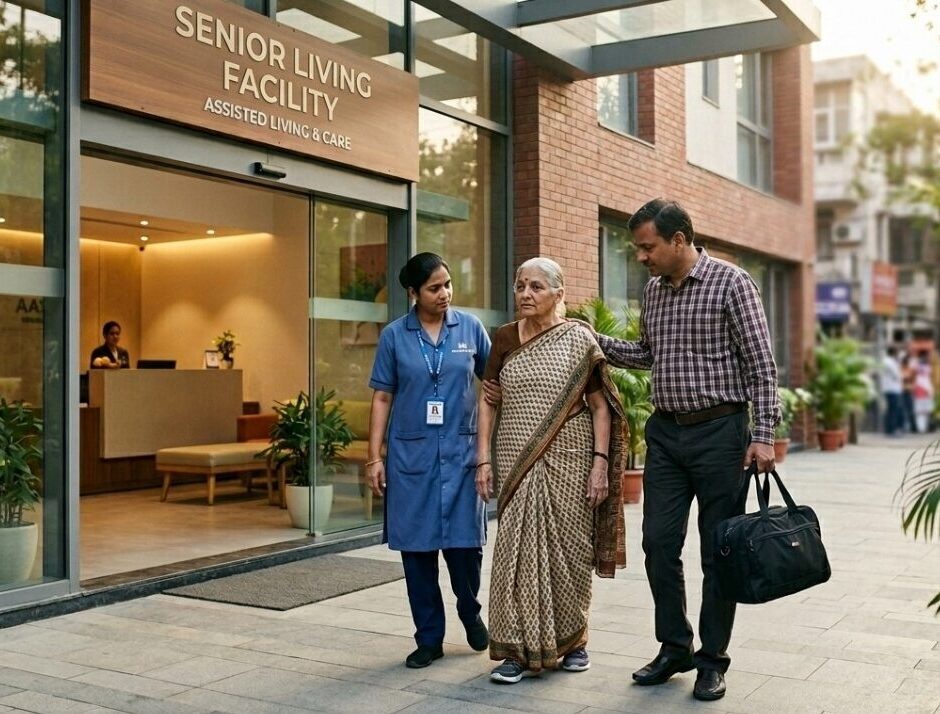
It usually happens after something breaks down.
Maybe it was a fall in the bathroom at 2 a.m. Maybe it was the third time this month your father forgot to eat. Or maybe it was your domestic help — the one who has held the household together for four years — quietly saying she cannot manage alone anymore.
Someone in the family finally says it out loud: “I think it’s time we looked at an old age home.”
The silence that follows is not just awkward. In a Kolkata family, it carries decades of unspoken obligation, of afternoons on the veranda, of the assumption that the family home is where you grow old. The parent often refuses outright. The son in Bengaluru or the daughter in Toronto feels a guilt that is sharp and specific — the guilt of not being in the same room.
In Kolkata, the conversation about an old age home still carries a stigma that the data doesn’t support. But before you decide anything, it is worth understanding what you are actually choosing between.
What most families discover when they start this process
The decision is not binary. It is not “old age home vs nothing.” It is “old age home vs properly structured home care.” Most families, when they see what professional home care in Kolkata can actually deliver today, realise they have been comparing the wrong things.
Why families start searching for old age homes in Kolkata
Most families do not search for old age homes because they want to. They search because they are exhausted, worried, or both.
The triggers are usually one of five things. First, a safety incident — a fall, a confusion episode, a wandering event at night. Second, a caregiver reaching her limit — the domestic help, often a woman managing everything alone, is simply overwhelmed. Third, a medical change — a new diagnosis of dementia, a stroke, a fracture that has changed the parent’s functional ability permanently. Fourth, a parent’s own insistence on independence that makes home care difficult to structure properly. Fifth, the sheer logistical weight of managing care remotely from another city or country.
These are all legitimate reasons. None of them require judgment. And in some situations, a residential care facility is genuinely the right answer.
However, most families arrive at this search without fully understanding what the alternative actually looks like. They are comparing an old age home against a vague idea of “managing at home” — rather than against a properly structured home care plan.
Before deciding — what is home care in Kolkata actually capable of?
There is a common assumption that home care means a domestic helper who helps with bathing and cooking. That assumption is now significantly out of date.
Professional home care in Kolkata today can include: a daily nurse visit for medication management and vitals monitoring; physiotherapy at home after a stroke, hip fracture, or surgery; a trained live-in carer for 24-hour support; cognitive engagement programmes for parents with mild to moderate dementia; regular written reports that families in Salt Lake or Singapore can read the same evening; and a care coordinator who acts as the single point of contact across all providers.
The pricing reflects the range of need. A weekly coordinator visit and monitoring plan starts at approximately Rs 8,000 per month. A daily nurse visit plan is typically Rs 15,000 to Rs 25,000 per month. A full 24-hour live-in care arrangement, with trained carer, supervisor visits, and clinical oversight, ranges from Rs 40,000 to Rs 80,000 per month depending on the level of clinical need.
For a parent with moderate care needs — someone who needs daily support but is not requiring round-the-clock clinical monitoring — structured home care is often both cheaper and more effective than a residential facility. It preserves the parent’s familiarity, diet, and sense of dignity. It allows care to be genuinely personalised rather than institutionally standardised.
Families in Ballygunge, Alipore, and Tollygunge have been running these arrangements successfully. The model works when it is properly structured.
When home care is the better choice — a checklist
- Parent can live in familiar surroundings safely with adequate support in place
- Family has a local anchor — a sibling, a trusted domestic help, or a nearby relative — who can coordinate day-to-day
- Parent’s condition does not require 24-hour clinical monitoring that cannot be delivered at home
- Parent has strong resistance to moving to a residential facility
- Family can afford Rs 15,000 to Rs 50,000 per month for professional care support
- NRI family can manage care oversight via regular written reports and WhatsApp coordination with a care coordinator
When an old age home in Kolkata is genuinely the right answer
Honesty matters here, because this is what builds trust. There are specific circumstances where residential care is not just a reasonable option but the genuinely better one.
Late-stage dementia with aggressive episodes is one. When a parent is experiencing regular episodes of aggression, extreme agitation, or significant nocturnal wandering, the safety and staffing requirements become very difficult to sustain at home — even with a live-in carer.
Parents with no local anchor and no home that can be made structurally safe are another case where residential care is often the right recommendation. If the parent lives alone in a third-floor flat in a building with no lift, and there is no family member within an hour’s distance, the risk calculus changes significantly.
Finally, there are parents who genuinely prefer residential community living. Not every parent refuses. Some actively seek the social structure and relief from domestic responsibility that a well-run facility provides.
For premium residential care in Kolkata, Tribeca Senior Living (tribecaseniorliving.com) is a relevant option. A note on the Tata Steel Foundation old age home, which appears frequently in search results: TSAF operates a welfare model — it is designed for economically vulnerable seniors, not private-pay families. For mid-range private facilities, monthly fees typically run Rs 20,000 to Rs 40,000. For premium facilities, costs range from Rs 60,000 to Rs 1,50,000 per month.
The right question
The right question is not “old age home or home care.” It is: “What does my parent actually need in the next six months?” That question — answered honestly and specifically — usually points clearly in one direction.
How to have the conversation with your parent
This is often the hardest part. Harder than the logistics. Harder than the costs. Because the conversation is not really about care — it is about loss, about dependence, about what home means.
The framing matters enormously. Do not begin with “I think you need to move” or “I think you need someone to look after you.” Begin instead with what has changed and what you want to add. “Tomar shathe thakbo, kintu ektu sahayta dorkar” — I’ll be with you, but you need a little help. That construction — adding support rather than removing independence — changes what the parent hears.
Most parents refuse at first. That refusal is not irrational. It is an entirely reasonable response to what feels like the beginning of the end. Give it time. Come back to it. Do not have the conversation in a moment of crisis — have it in a calm afternoon, without an agenda, without a solution already decided.
If you are managing this from abroad, the conversation is harder because your parent will often minimise to protect you. They will say things are fine when they are not. Build in a trusted local person — a family friend, a neighbour, a coordinator — who can give you an honest picture separate from what your parent tells you directly.
NRI families in particular benefit from having a care coordinator who can be the eyes on the ground — someone whose job is to give you accurate, unvarnished information, not to manage your feelings.
What to do this week — not someday
Most families in this situation say they will figure it out soon. Soon becomes months. Months become a crisis that forces a rushed decision.
Here is what to do this week, specifically. First, write down the three things your parent cannot currently do safely without help. Not a general sense of concern — specific activities. Bathing alone. Taking medication without a reminder. Walking to the bathroom at night.
Second, identify whether there is a local anchor. One person — family, neighbour, or trusted domestic help — who can be the coordination point on the ground. If that person does not exist, the calculus changes.
Third, get a professional assessment. A Tribeca coordinator can visit your parent’s home in areas like New Alipore or Jadavpur, assess the environment and the care need, and give you a specific written recommendation. That recommendation will tell you clearly whether home care is viable and at what cost — or whether residential care genuinely makes more sense for your parent’s situation.
Only after that assessment should you make the residential vs home care decision. Not before.
Frequently Asked Questions
What is the monthly cost of a private old age home in Kolkata?
Private old age homes in Kolkata range widely. At the basic end, private-pay residential facilities charge Rs 12,000 to Rs 20,000 per month for shared accommodation with standard meals and basic nursing oversight. Mid-range facilities — typically in better-maintained buildings with more individual attention — run Rs 20,000 to Rs 40,000 per month. Premium facilities, including those with single rooms, more clinical staff per resident, and structured activity programmes, charge Rs 60,000 to Rs 1,50,000 per month. These prices generally include accommodation, meals, and basic nursing care but may charge separately for incontinence supplies, specialist visits, or physiotherapy. The Tata Steel Foundation old age home is a welfare model and is not relevant to private-pay families seeking quality residential care.
Q: What is the cost of an old age home in Kolkata vs home care?
A: Government and welfare-model old age homes in Kolkata charge Rs 0 to Rs 5,000 per month, but waitlists are long and facilities are basic. Mid-range private facilities run Rs 20,000 to Rs 40,000 per month. Premium facilities charge Rs 60,000 to Rs 1,50,000 per month depending on room type and clinical services included. Professional home care from Tribeca runs Rs 8,000 to Rs 80,000 per month depending on care intensity. For parents with moderate care needs — the majority of families who contact us — structured home care is typically less expensive than a mid-range residential facility, and delivers a higher quality of personalised attention.
Can professional home care in Kolkata actually replace an old age home?
For most families dealing with moderate care needs — where the parent needs daily support but is not requiring round-the-clock clinical monitoring — yes. Professional home care in Kolkata has matured significantly. A properly structured plan includes a care coordinator, daily or weekly nurse visits, medication management, physiotherapy at home, and regular reporting for families managing remotely. The key condition is that there is a safe home environment and at least one local anchor for coordination. Where those conditions are met, home care typically delivers better personalised care than a residential facility at a comparable or lower cost. Where they are not met — no safe home, no local support, very high clinical need — a residential facility is the more appropriate choice.
Q: Are there good alternatives to old age homes in Kolkata for elderly parents?
A: Yes — and they have improved significantly in the last five years. The main alternatives are: structured home care with a professional coordinator and visiting nurse; live-in carer arrangements for 24-hour support; and senior day programmes for parents who benefit from social engagement but live at home. For most families where the parent can be kept safely at home with support — which is the majority of moderate-need situations — a coordinator-led home care plan is better than a residential facility on most practical dimensions: familiarity, personalised diet, cost-effectiveness, and the parent’s own sense of dignity. Tribeca Care offers structured home care plans with a single coordinator managing all providers, with regular reporting for families managing from another city or country.
How do I find the best old age home in Kolkata for my parent?
Start by being specific about what your parent actually needs: level of clinical care, mobility, cognitive status, social preferences, and proximity requirements for visiting family. Visit any facility you seriously consider — check staffing ratios, not just promotional materials. Ask specifically about what happens when a resident’s needs escalate. For premium residential care, Tribeca Senior Living (tribecaseniorliving.com) is a relevant option. However, before committing to residential care, we would recommend getting a professional home care assessment first. In many cases, families who come to us looking for an old age home discover that structured home care is a more suitable and cost-effective solution. If residential care genuinely is the right answer, we will tell you that directly — and help you find a well-run facility.
Related articles
Get an honest assessment — not a sales pitch
A Tribeca care coordinator will visit your parent at home and tell you clearly: whether home care can meet the need, what a realistic plan would cost, and whether residential care would serve your parent better. We have no incentive to oversell either option.
This is not an emergency service and not a sales call. If the honest answer is that an old age home is genuinely right for your parent’s situation, we will tell you that — and help you find a good one.
Need a professional home safety assessment?
Our team can assess your parent's home environment room by room, identify structural risks a checklist won't catch, and create a prioritised safety plan - starting at ₹999.
Book a Home Risk Audit