How to Move a Parent into an Old Age Home in Kolkata: A Step-by-Step Guide for Families
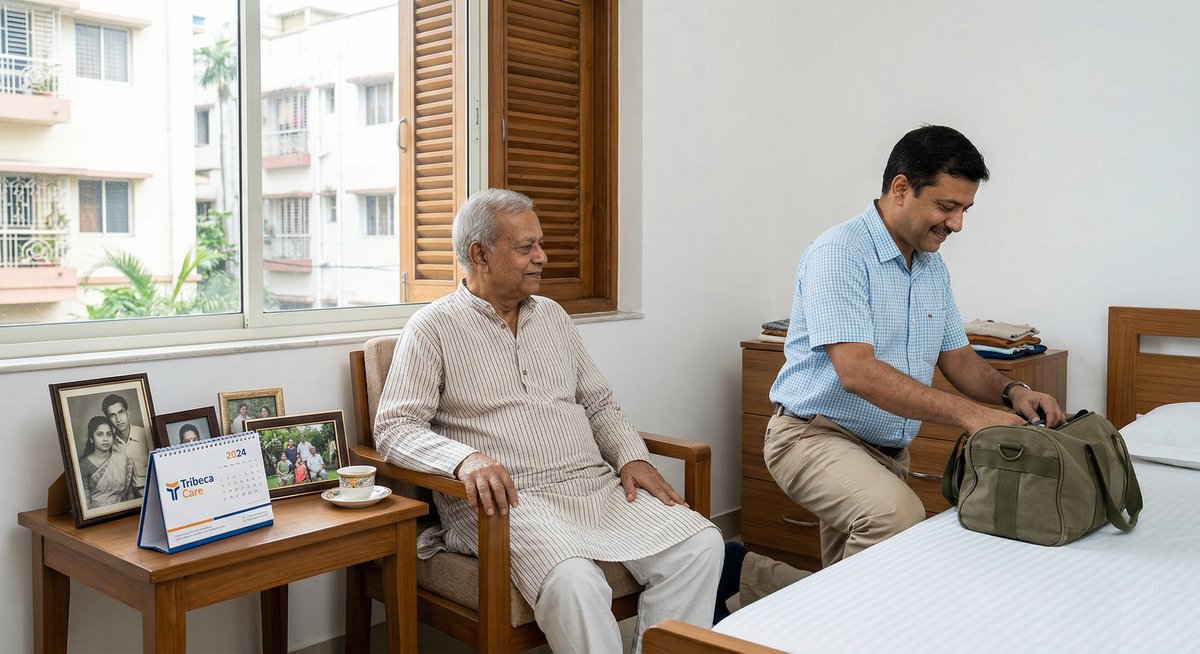
Your sibling calls from London. Or WhatsApp at midnight. “Dadu porhe gechhe. Floor e.” Not a fall—a moment. The moment you realize one or two attendants are no longer enough. The moment you finally say out loud what the family has been thinking for months: “It’s time.”
Moving a parent into an old age home in Kolkata is rarely a sudden decision. It is the end of a long conversation that most families have in fragments—a WhatsApp call here, a family gathering there—and the beginning of something equally hard: the execution week.
Tribeca field data shows the dementia care cycle is the most common pathway into residential care in Kolkata. When memory loss reaches the stage where night wandering, aggression, or complete personal care dependency exceeds what one or two attendants can safely manage, families move. But they rarely know what to do in the weeks before and after. The hardest moment is not the decision—it’s the execution week.
Most families spend months deciding. Then they spend four days panicking.
The decision happens slowly—clinical observations, midnight conversations, the moment when someone finally admits the parent is not safe at home anymore. But the actual move happens fast. A bed opens up. A facility confirms. And suddenly you have one week. The gap between deciding and doing is where families go wrong. This is not a lack of love. It’s a lack of structure.
What the admission process looks like for Kolkata facilities
The process typically involves: a trial visit or short stay to assess fit, a health assessment by the facility, signing a residence agreement and paying the deposit, preparing personal belongings (familiar items matter enormously for dementia patients), the move itself, and a structured adjustment period in the first 4–6 weeks. NRB/NRI families should coordinate a trusted local contact to manage the physical move.
For most facilities, 1–3 weeks if a bed is available. Premium facilities with waiting lists may take longer. The health assessment and paperwork can usually be done within a few days. Factor in time for a local representative to do facility visits and confirm the right fit.
Kolkata’s old age home landscape ranges from basic residential facilities to premium assisted living communities. Deposit requirements typically range from ₹50,000–₹2,00,000. Monthly fees run from ₹15,000–₹80,000 depending on facility type and care level.
The week before the move is what determines whether it goes well—not the month before.
Most families over-prepare emotionally and under-prepare practically. The checklist below covers what actually needs to happen in the 4 weeks before the move date. Share it with whoever is managing things on the ground.
The checklist: what to do in the 4 weeks before the move
Pre-move checklist for Kolkata families
- Confirm the parent’s health records, medication list, and any prescriptions the facility will need. Bring originals or certified copies.
- Create a one-page summary: blood type, allergies, current medications, hospital admission history, and emergency contacts. Print copies.
- Review the residence agreement carefully. NRI families: have a trusted local representative review it before signing.
- Pack personal items but avoid valuables. Keep one bag ready for the first night.
- If dementia is present, photograph the parent’s room at home. The facility will use these photos to orient them during the first few weeks.
What to bring (and what to leave behind)
Familiar personal items are as important as practical ones. Bring: familiar bedding (ideally their own pillow or a pillowcase with the same scent), family photographs, preferred clothing in familiar sizes, hearing aids and glasses with spare prescriptions, medication list and prescription records, emergency contact list, and any religious or comfort items meaningful to the parent.
Avoid bringing valuables—jewellery, large amounts of cash, or important documents. For dementia patients, familiar smells and objects significantly ease the transition. This is not sentimental luxury. It is clinical necessity.
Q: How do I move a parent with dementia into an old age home in Kolkata without making it worse?
A: The key is environment continuity. Before the move, photograph their room at home—walls, furniture arrangement, personal items. Share these with the facility so staff can recreate familiar sight-lines in their new room. Bring their pillow, a favourite blanket, and at least one family photograph for each wall. On move day, have the local person your parent trusts most present in the room. Do not use the word “permanent.” Frame it as a short trial. Most dementia patients settle faster when the physical environment contains familiar anchors—smells, textures, faces. The first 72 hours are the hardest. Plan for daily short visits in the first week, then step back to 3–4 times per week to let the new routine form.
How to handle a parent who refuses to go
The parent who says “I’m fine” is often protecting you. That protection is both generous and dangerous.
Resistance is normal. Sometimes it is tactical—a negotiation to stay home longer. Sometimes it is genuine fear. Do not argue about safety. Instead, reframe the move as a short-term trial. “Let’s try it for three weeks and see how it goes.” Most parents adjust faster when they believe it is temporary. Most never ask to leave once they settle in.
For NRI families, the local person who is present matters enormously. The parent will trust the voice they know in the room more than a voice from abroad on a phone call.
The first 6 weeks after the move: what to expect
The first 72 hours are adjustment. The first 2–3 weeks are crisis. The first 6 weeks determine whether the move sticks.
Expect behavioral changes: increased restlessness, anxiety, or confusion in the afternoons. This is normal. Expect the parent to ask repeatedly when they can go home, and expect this to ease. Visit consistently in the first 6 weeks—not daily, but 3–4 times per week at consistent times.
If dementia is present, always ask: Does the facility manage night wandering with supervision or restraint? Do they handle aggression with medication or with activity-based intervention? These answers will clarify whether you have made the right choice.
Q: How do NRI families manage moving a parent into an old age home in Kolkata from abroad?
A: The gap is not information—it’s local execution. You can research facilities, interview staff via video call, and make the final decision from London or Singapore. But you need a local anchor: a sibling, cousin, trusted family member, or lawyer who can visit facilities in person, sign documents, and be present on move day. For the practical side: hire a local moving service rather than relying on family with a car. Confirm deposit and payment structures in advance. After the move, stay connected via weekly video calls with both your parent and the facility’s care coordinator. The structure—timeline, checklist, clear local anchor—is what transforms overwhelming into manageable.
How NRB and NRI families manage the move from abroad
If you are reading this from London or Singapore, the question is not whether to move your parent. It is who your local anchor is. This is the person—a sibling, cousin, trusted family member, or lawyer—who can visit facilities, sign documents, and be present in the room on the first day.
For the move itself: hire a local moving service, not a family member with a car. Coordinate the facility visit with your local anchor at least one week before. After the move, stay connected via weekly video calls with both your parent and the care coordinator.
Questions to ask a facility before signing anything
→ What is your staff-to-resident ratio, specifically for memory care?
→ How do you manage night wandering and aggression if they occur?
→ What is your readmission policy if my parent struggles in the first 30 days?
→ Who is available for emergency calls at night?
→ Can I bring my parent’s own bedding and personal items?
→ What is the cancellation policy if I decide the move is wrong?
→ What does the monthly fee include? What costs extra?
Not all old age homes in Kolkata are equipped for advanced dementia. Always ask specifically about staff ratio for memory care residents. The answers will tell you everything.
Frequently Asked Questions
How long does it take to get a parent admitted to an old age home in Kolkata?
For most facilities, 1–3 weeks if a bed is available. Premium facilities with waiting lists may take longer. NRB/NRI families should factor in time for a local representative to do facility visits.
Can a parent with dementia be admitted to an old age home in Kolkata?
Yes, but the facility must have memory care capacity. Not all old age homes in Kolkata are equipped for advanced dementia. Always ask specifically about the staff ratio for memory care residents. This single question reveals more than any brochure.
What is the process for moving an elderly parent into an old age home in Kolkata?
The process typically involves: a trial visit or short stay to assess fit, a health assessment by the facility, signing a residence agreement and paying the deposit, preparing personal belongings, the move itself, and a structured adjustment period in the first 4–6 weeks.
What should I bring when moving my parent to an old age home in Kolkata?
Bring: familiar bedding, family photographs, preferred clothing, hearing aids and glasses with spares, medication list and prescription records, emergency contact list, and any religious or comfort items. Avoid bringing valuables. For dementia patients, familiar smells and objects significantly ease the transition.
Related articles
Not sure where to start?
Tribeca Care works with families at every stage of the transition into residen
Need a professional home safety assessment?
Our team can assess your parent's home environment room by room, identify structural risks a checklist won't catch, and create a prioritised safety plan - starting at ₹999.
Book a Home Risk Audit