A structured assessment that maps your parent’s current needs, identifies the right level of care, and produces a written plan with specific recommendations. Priority callback within 4 hours for families in urgent situations.
Care Guide
When Is It Time for Full-Time Care in Kolkata? Signs, Stages, and How to Decide
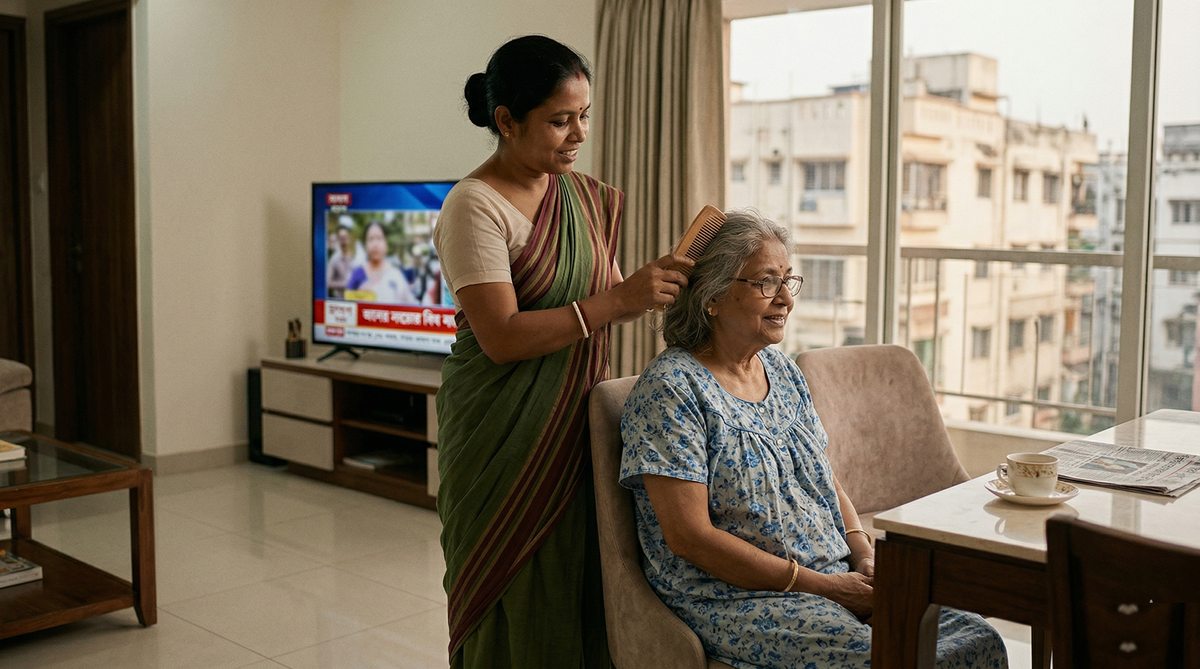
When Is It Time for Full-Time Care in Kolkata? Signs, Stages, and How to Decide
The decision to move to full-time care is rarely sudden. It builds — a missed meal, a fall, a medication forgotten, a night no one can account for. Most families delay the conversation longer than they should. This guide helps you recognise the signs, understand the stages, and make the decision with clarity rather than in crisis.
When Is It Time for Full-Time Care? Signs, Stages, and How to Decide
Across Tribeca Care’s 2,200 member families in Kolkata, the move to full-time care is delayed by an average of 8 to 12 months after the first clear signal — most often because no one can agree on what that signal means. This guide identifies the seven signs that part-time help is no longer enough, and what the realistic options look like when that point arrives.
Seven Signs Part-Time Help Is No Longer Enough
Part-time help — a domestic helper for 6 to 8 hours a day, or a nurse who visits for medication and personal care — works well when the person has residual independence for the periods in between. When that independence erodes, the gaps between support periods become dangerous.
1. Falls or near-falls during unsupervised periods. If your parent is falling when no one is there, the risk during the next unsupervised period is not going to be lower. Part-time arrangements cannot cover this risk.
2. Medication non-compliance. Missing doses, doubling doses, or confusing medications — particularly insulin, blood thinners, heart medications, or anything with a narrow therapeutic window — is a medical emergency waiting to happen that a daily helper cannot reliably prevent.
3. Nutritional decline. Significant weight loss, eating irregularly or not at all, or relying on biscuits and tea because meals require too much effort. A helper who is not present for all meal times cannot catch this.
4. Hygiene deterioration. If your parent is not bathing, not managing personal hygiene, or wearing the same clothes for multiple days — and this represents a change from previous behaviour — it indicates cognitive or physical decline that exceeds what part-time support can address.
5. Social withdrawal and isolation. Stopping activities they previously enjoyed, not answering the phone, expressing hopelessness or resignation. Isolation is both a symptom of decline and an accelerant of it.
6. Unsafe behaviour during unsupervised periods. Leaving the gas on, opening the door to strangers, giving money to people who visit, or making decisions that suggest significant cognitive impairment.
7. Caregiver collapse. If the primary family caregiver is visibly exhausted, unwell, or unable to sustain the current level of support, the arrangement has already broken down even if the care recipient appears to be managing.
The question is not whether your parent needs more care — it is whether the current arrangement can safely provide it.
Most families know the answer before they ask the question. The gap between knowing and acting is usually about guilt, disagreement among siblings, or the difficulty of having the conversation with a parent who does not want to acknowledge the change.
Attendant vs Supervised Care: What Is the Difference
Full-time care can mean very different things, and the distinction matters both for the quality of care and for the cost.
A full-time attendant is a person — typically a domestic helper on extended hours, or an agency-placed attendant — who is physically present with the elderly person for most of the day and night. They provide company, basic personal care, meal support, and call for help if needed. They are not clinically trained, do not provide medical care, and are not supervised by a qualified professional. This arrangement is appropriate for someone who needs continuous physical presence and basic support but does not have complex medical needs.
Supervised care (sometimes called managed home care) adds a qualified clinical layer — a nurse or care manager who oversees the attendant’s work, conducts regular assessments, manages medications, interfaces with the GP, and provides the family with structured reports. This is appropriate for someone with complex medical needs, significant cognitive impairment, or a condition that is likely to change over time.
Most families underestimate how quickly an attendant-only arrangement escalates to needing supervised care once the person’s condition starts to progress. Building the clinical oversight layer in early reduces the risk of being caught unprepared when a health event changes the situation.
Before the Family Conversation: What to Agree On
- Which family members are involved in this decision — and who has the final authority if consensus is not reached
- What specific behaviours or events will trigger the move to full-time care — agree on these before they happen, not during a crisis
- What the acceptable options are — attendant at home, supervised care at home, a care facility — and what each family member’s position is on each option
- Who is currently providing care and whether that person has a right to be involved in the decision
- What the parent’s stated preferences are — even if they resist the idea, they may have views on format and personnel that should be factored in
When a Parent Refuses Full-Time Help: What Actually Works
- Start with companionship framing — “someone to keep you company” is more acceptable than “someone to look after you”
- Introduce the helper gradually — a few hours initially, building over weeks rather than an overnight change to full-time presence
- Let the parent influence the choice of person — giving agency over who enters their home reduces resistance significantly
- Use the doctor’s authority — a GP who frames full-time support as a medical recommendation carries weight that a family member’s judgment does not
- Focus on the family’s need rather than the parent’s — “I cannot sleep at night worrying about you” is often more persuasive than any argument about the parent’s own safety
The decision delays that hurt most happen when siblings disagree and nothing gets decided.
In our experience across 2,200 Kolkata families, the most common reason for delayed transition to appropriate care is not the parent’s resistance — it is unresolved disagreement between adult children about what should happen. Often, the sibling who is locally present and bearing the care burden has reached a decision that siblings at a distance have not yet accepted. This dynamic needs to be named and addressed directly.
What Full-Time Care Looks Like at Home vs Facility
In Kolkata, the large majority of families opt for home-based full-time care rather than a residential facility, and for most situations this is both feasible and preferable — particularly for elderly adults who are cognitively intact and have strong attachments to their home and neighbourhood.
Full-Time Care at Home
Involves a 24-hour attendant presence (typically two shifts), regular clinical oversight from a nurse or care manager, GP and specialist management, and family-facing reporting. The person remains in their home environment, retains their social connections, and has care tailored to their specific needs and preferences. This is the most preferred option in Kolkata for families who can organise it, and Tribeca Care supports approximately 300 households in this model.
Residential Care Facility
Appropriate when the home environment cannot be made safe (structural limitations, no space for a live-in attendant), when specialist nursing care is required on a continuous basis, or when the person's cognitive impairment is advanced enough that the familiar home environment is no longer providing an orienting function. The quality of residential facilities in Kolkata varies significantly — visiting in person, speaking to residents and families, and checking staff-to-resident ratios are essential steps before a decision.
Hybrid Arrangements
Some families use a day facility or day programme for 4 to 6 hours while the parent returns home in the evenings. This reduces isolation, provides structured activity and clinical oversight during the day, and reduces the burden on the family or domestic helper at home. Appropriate for early-to-middle stage cognitive decline or for post-hospitalisation recovery where full-time nursing care is needed temporarily.
Full-Time Care at Home
Involves a 24-hour attendant presence (typically two shifts), regular clinical oversight from a nurse or care manager, GP and specialist management, and family-facing reporting. The person remains in their home environment, retains their social connections, and has care tailored to their specific needs and preferences. Tribeca Care supports approximately 300 households in this model across Kolkata.
Residential Care Facility
Appropriate when the home environment cannot be made safe, when specialist nursing care is required on a continuous basis, or when the person's cognitive impairment is advanced enough that the familiar home environment is no longer providing an orienting function. The quality of residential facilities in Kolkata varies significantly — visiting in person, speaking to residents and families, and checking staff-to-resident ratios are essential steps before a decision.
Hybrid Arrangements
Some families use a day facility or day programme for 4 to 6 hours while the parent returns home in the evenings. This reduces isolation, provides structured activity and clinical oversight during the day, and reduces the burden on the family or domestic helper at home. Appropriate for early-to-middle stage cognitive decline or for post-hospitalisation recovery where full-time nursing care is needed temporarily.
Making the Transition: What Good Planning Looks Like
The transition to full-time care is most successful when it is planned rather than triggered by a crisis. Families who plan tend to introduce the change gradually, involve the parent in the selection of the care person, and stage the transition over two to four weeks rather than implementing it overnight.
The starting point is a care assessment — a structured evaluation of the person’s current needs, the home environment, and the family’s capacity and preferences. The assessment produces a care plan that specifies what level of support is needed, what format is appropriate, and what clinical oversight is required.
The most common mistake in this transition is hiring too quickly under pressure. A care person who is a poor fit — wrong personality, wrong language, wrong experience — will be rejected by the parent and exits the arrangement within weeks, often leaving the family in a worse position than before.
Signs You Need to Act Now Rather Than Wait
☑ Tick what applies to your parent's home. Then screenshot this list and send it to a sibling or caregiver - it's easier to fix things when everyone sees the same gaps.
Your parent has had two or more falls in the past three months, with or without injury — the risk of a serious fall is now significantly elevated.
A GP or specialist has told you that continuous supervision is medically necessary but you have not yet arranged it.
Your parent is managing complex medications (insulin, blood thinners, cardiac drugs) without reliable daily oversight.
The person currently providing care — a spouse, a sibling, or a domestic helper — has told you they cannot continue at the current level.
Your parent has been hospitalised in the past six months, has been discharged home, and the home support arrangement has not changed.
You are receiving calls from neighbours, building staff, or others in the community who have noticed something is wrong.
Your parent has had two or more falls in the past three months, with or without injury — the risk of a serious fall is now significantly elevated.
A GP or specialist has told you that continuous supervision is medically necessary but you have not yet arranged it.
Your parent is managing complex medications (insulin, blood thinners, cardiac drugs) without reliable daily oversight.
The person currently providing care — a spouse, a sibling, or a domestic helper — has told you they cannot continue at the current level.
Your parent has been hospitalised in the past six months, has been discharged home, and the home support arrangement has not changed.
You are receiving calls from neighbours, building staff, or others in the community who have noticed something is wrong.
How Tribeca Care Supports the Transition to Full-Time Care
Tribeca Care’s Care Level Assessment is designed for families who are at or approaching this decision point. The assessment covers the person’s current functional status, their medical complexity, the existing care arrangement and its gaps, the family’s preferences and constraints, and the home environment. It produces a written care plan that specifies the right level of support and format for your parent’s situation.
We manage the transition rather than just advising on it — we handle the selection of care personnel, train them for your parent’s specific needs, oversee the initial weeks of the arrangement, and remain available for adjustment as the situation evolves. For the majority of families, full-time care that is well-matched and well-managed is sustainable and stabilising — both for the parent and for the family.
If you’d like to understand what structured care looks like in practice, Tribeca Care’s care plans range from emergency-only coverage to full daily coordination — designed specifically for Kolkata families at different stages of need.
Get a Care Level Assessment
- Structured care needs assessment at home
- Written care plan with level and format recommendations
- Care personnel selection and matching
- Ongoing care management and clinical oversight
✓ This is not an emergency service and not a sales call. If the situation appears low-risk, you'll be told that plainly. You decide what, if anything, to do next. You can opt out at any time.
Frequently Asked Questions
The cost depends on the level of care required. An attendant-only arrangement (domestic helper on extended hours or an agency-placed attendant for 12 to 16 hours a day) typically ranges from ₹18,000 to ₹35,000 per month depending on experience and hours. A fully managed care arrangement with clinical oversight, care manager visits, and structured reporting ranges from ₹40,000 to ₹80,000 per month depending on medical complexity. We provide a cost estimate as part of the care assessment, once we understand the actual level of support required.
This is the most common challenge in the transition to full-time care, and it is rarely insurmountable. The approach that works best is gradual introduction — starting with a few hours of companionship per day and building over two to four weeks — combined with giving the parent some agency in the selection of the person. Having the GP frame the support as a medical recommendation also helps significantly. We have managed this transition for hundreds of families and can advise on the specific approach that is likely to work for your parent’s personality and situation.
Family care is deeply meaningful and, in early stages, often sufficient. As care needs escalate, the limitations of informal family care become significant: physical demands that lead to caregiver injury, the emotional difficulty of maintaining a normal relationship with a parent while also providing intimate personal care, and the absence of clinical knowledge for managing complex medical situations. Professional care does not replace family involvement — it handles the tasks that are most physically and emotionally demanding, freeing the family for the relationship. The two work best in combination.
The cost depends on the level of care required. An attendant-only arrangement typically ranges from ₹18,000 to ₹35,000 per month depending on experience and hours. A fully managed care arrangement with clinical oversight, care manager visits, and structured reporting ranges from ₹40,000 to ₹80,000 per month depending on medical complexity. We provide a cost estimate as part of the care assessment, once we understand the actual level of support required.
This is the most common challenge in the transition to full-time care, and it is rarely insurmountable. The approach that works best is gradual introduction — starting with a few hours of companionship per day and building over two to four weeks — combined with giving the parent some agency in the selection of the person. Having the GP frame the support as a medical recommendation also helps significantly.
Family care is deeply meaningful and, in early stages, often sufficient. As care needs escalate, the limitations of informal family care become significant: physical demands that lead to caregiver injury, the emotional difficulty of maintaining a normal relationship with a parent while also providing intimate personal care, and the absence of clinical knowledge for managing complex medical situations. Professional care does not replace family involvement — it handles the tasks that are most physically and emotionally demanding, freeing the family for the relationship.
Need a professional home safety assessment?
Our team can assess your parent's home environment room by room, identify structural risks a checklist won't catch, and create a prioritised safety plan - starting at ₹999.
Book a Home Risk Audit