Alzheimer’s and Dementia: Cognitive Assessment to Detect Abnormalities
Learn about cognitive testing, including MoCA, Mini-Cog, SAGE, MMSE, and AD8, and how these screening tools help detect early signs of cognitive impairment and dementia.

There are many types of cognitive assessments and screening tests used to detect early signs of dementia and mild cognitive impairment.
One early cognitive test is the Montreal Cognitive Assessment (MoCA). Others are Mini-Cog, and SAGE test. Each of these is a 3–15 minute screening tool used to detect mild cognitive impairment (MCI) or early dementia by assessing memory, language, executive function, and orientation. These screenings, often featuring word recall and clock-drawing tasks, help identify potential issues early to initiate further evaluation
- Montreal Cognitive Assessment (MoCA): A widely used 10-15 min test covering multiple domains, including attention, executive function, and memory.
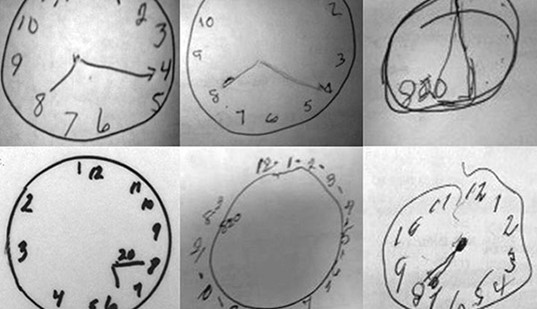
- Mini-Cog: A 3-minute screening that combines a 3-item recall task with a clock-drawing test, making it one of the quickest assessment tools.
- Self-Administered Gerocognitive Examination (SAGE): A take-home, self-administered test (roughly 15 minutes) designed to catch early signs of memory loss or dementia.
- Mini-Mental State Examination (MMSE): A traditional 30-point, 10-minute questionnaire assessing orientation and memory.
- AD8 Questionnaire: A brief 8-item informant questionnaire, usually filled out by a caregiver, to detect changes in memory, problem-solving, and daily functioning.
What early Cognitive Assessments measure?
These tests look for early, subtle changes in mental function rather than definitive diagnoses. They commonly test:
- Memory: Remembering a list of words or objects.
- Executive Function: Abstract reasoning, problem-solving, and planning.
- Visuospatial Abilities: Copying shapes or drawing a clock.
- Language and Orientation: Identifying objects, naming pictures, and knowing the date.
The following part of the article cites the Cleveland Clinic and refers to the website. https://my.clevelandclinic.org/health/articles/22306-cognitive-test
“Cognition is your brain’s ability to process all the information it takes in from your senses. Cognition includes:
- Attention skills
- Decision-making skills
- Judgment
- Language
- Learning
- Reasoning
- Remembering
- Thinking
- Understanding
This is also called a cognitive impairment test and a cognitive screening test.
Why Might I Need a Cognitive Assessment?
A healthcare provider may recommend a cognitive test if they suspect mental decline or cognitive impairment (issues with mental functioning). Some examples may include:
- You forget where you put things or you forget important dates or appointments regularly
- You have trouble finding the right words to say or forget what you are saying in the middle of a conversation
- You feel frustrated because tasks that used to be easy are challenging for you to do
Even if there isn’t any suspicion of an underlying health condition that affects cognition, your provider may still perform a cognitive test after age 65. This is due to natural changes in how your brain works as your body ages.
What does a cognitive test consist of?
A cognitive test consists of a few questions or tasks that you answer or perform to the best of your ability. This test doesn’t require you to research information (study) or prepare in any way. You’ll simply respond or follow the instructions that your provider gives you. It should only take a few minutes up to 15 minutes in total. It’s usually part of a regular health exam.
Where do I take this test?
You’ll take this test in a healthcare provider’s office. Depending on your needs, this may be done in a hospital setting, especially after an accident or traumatic brain injury.
What are the types of cognitive screening tests?
There are several types of cognitive tests. The three most common include:
- A test where you memorize a short list of words, name objects shown in pictures, and copy a drawing of a shape and other similar tasks. It takes about 15 minutes to complete.
- A test that involves counting, and identifying objects and other common, well-known facts. It takes about 10 minutes.
- A test that involves memorizing and recalling a three-word list of unrelated words. You’ll also draw a picture of a common object. This test usually takes about three minutes.

Cognitive test sample questions
Cognitive screening tests check various brain functions that relate to cognition. Some examples of questions or tasks your provider may ask include:
- Attention. Recall the names of three unrelated objects.
- Decision-making. Listen to a scenario and describe what you’d do (for example, “You forgot your grocery list and you’re at the store, what do you do?”).
- Judgment. Listen to a situation and describe how you’d react (for example, “If you saw someone get an injury, what would you do?”).
- Language. Follow verbal directions (for example, “Place your right hand on your left knee.”).
- Learning. Spell a five-letter word forward and backward. Read a sentence out loud, write a sentence down and repeat phrases.
- Reasoning. Complete a simple math problem (for example, “What is 2+5?”).
- Remembering. Describe an event that happened recently (short-term memory) or a few years ago (long-term memory).
- Thinking. Name the relationship between objects (for example, “A cat and a dog are both animals.”).
- Understanding. Identify what day it is and the city you’re in.
What can I expect after a Cognitive Assessment?
Your provider will give you more information about how you did after the test. If any questions were challenging or you had trouble answering a few, that’s OK — you don’t need a perfect score. Your provider may recommend additional testing if the results are abnormal. They’ll let you know what your situation looks like, as it can vary from person to person.
What are the downsides of the cognitive ability test?
The word “test” may stress you out. So, it’s normal to feel a bit nervous before you see your provider. But this isn’t a typical diagnostic test or an exam you take in school. This type of test is quick and assesses your thinking abilities.
It requires follow-up testing to make a diagnosis, especially if your provider suspects mild cognitive impairment or dementia.
Results and Follow-Up:
What do cognitive screening test results show?
Cognitive screening tests reveal if there’s a problem with mental functioning. However, the test can’t diagnose a specific disease, and it doesn’t reveal the severity, cause or location of impairment in your brain.
The test results come as a score that’s either normal or below normal. A normal score may mean you’re your brain is functioning as expected. But in some cases, you may still have symptoms of an underlying cognitive impairment with a normal score. Additional testing may be necessary.
A below-normal score means that your provider suspects cognitive impairment. They’ll recommend follow-up testing or recommend you see a neurologist. This is a provider who specializes in diagnosing and treating conditions that affect your brain. Your provider may order a neuropsychological assessment.”
A note from Cleveland Clinic –
You might feel intimidated by the word “test,” but there’s nothing to fear during a cognitive test. This is more of an evaluation that gives a healthcare provider more insight into how your brain works. It only takes a few minutes, and you should receive a score shortly after taking the test.
But knowing your score is only the start of the process. You’ll need additional testing to learn more. Your provider will explain your score and the next steps, if you need to take any. If you have any questions about the test or what you can expect following a cognitive test, your care team is here to help.
https://www.alz.org/getmedia/9687d51e-641a-43a1-a96b-b29eb00e72bb/cognitive-assessment-toolkit
