A structured, in-home assessment that covers all six fall risk factors and produces a prioritised action plan specific to your parent’s situation and home.
Care Guide
Fall Prevention for Elderly Parents in Kolkata: A Practical Guide
A fall is not just an accident — it is almost always the result of a predictable risk that was not addressed in time. Most families think about fall prevention after the first fall. This guide is for families who want to get ahead of it, and for those who have already had a scare and need to act now.
Fall Prevention for Elderly Parents at Home: A Practical Guide
According to WHO data, approximately 684,000 fatal falls occur globally each year, and the majority involve preventable environmental and behavioural factors. For families with an elderly parent in Kolkata — whether you are nearby or managing from another city — this guide covers the six risk factors and what to do about each one before a fall happens.
Why Falls Happen: Six Risk Factors
Falls in elderly adults are almost never caused by a single factor. They result from a combination of the person’s physical state, their medication, their environment, and their behaviour. Understanding which factors are present in your parent’s situation is more useful than generic advice about ‘being careful’.
1. Muscle weakness and balance problems. The most common underlying cause. Age-related muscle loss reduces leg strength and core stability, making recovery from a stumble slower and less reliable. Reversible with targeted exercise in many cases.
2. Medication effects. Many common medications — blood pressure drugs, sleeping pills, antihistamines, diuretics, antidepressants — cause dizziness, low blood pressure on standing, or slowed reflexes. Polypharmacy (taking four or more medications) multiplies the risk significantly.
3. Vision problems. Uncorrected refractive errors, cataracts, and glaucoma reduce depth perception and contrast sensitivity. Many elderly adults are walking around with significantly impaired vision that could be corrected.
4. Environmental hazards. Loose rugs, inadequate lighting, absent grab bars, slippery bathroom floors, and cluttered pathways. These are the most directly modifiable factors.
5. Footwear and clothing. Unsupported slippers, bedroom chappals worn for longer distances, and long nightclothes that catch on furniture or the floor.
6. Chronic conditions. Parkinson’s disease, arthritis, previous stroke, diabetes-related neuropathy, and heart conditions that cause sudden dizziness.
Most falls are not accidents — they are predictable events with identifiable causes.
A structured fall risk assessment identifies which of the six factors are present in your parent's situation and prioritises the interventions with the highest impact. This is not a generic checklist — it is specific to the person, the home, and the combination of risks they face.
Bathroom — Grab Bars and Anti-Slip Surfaces
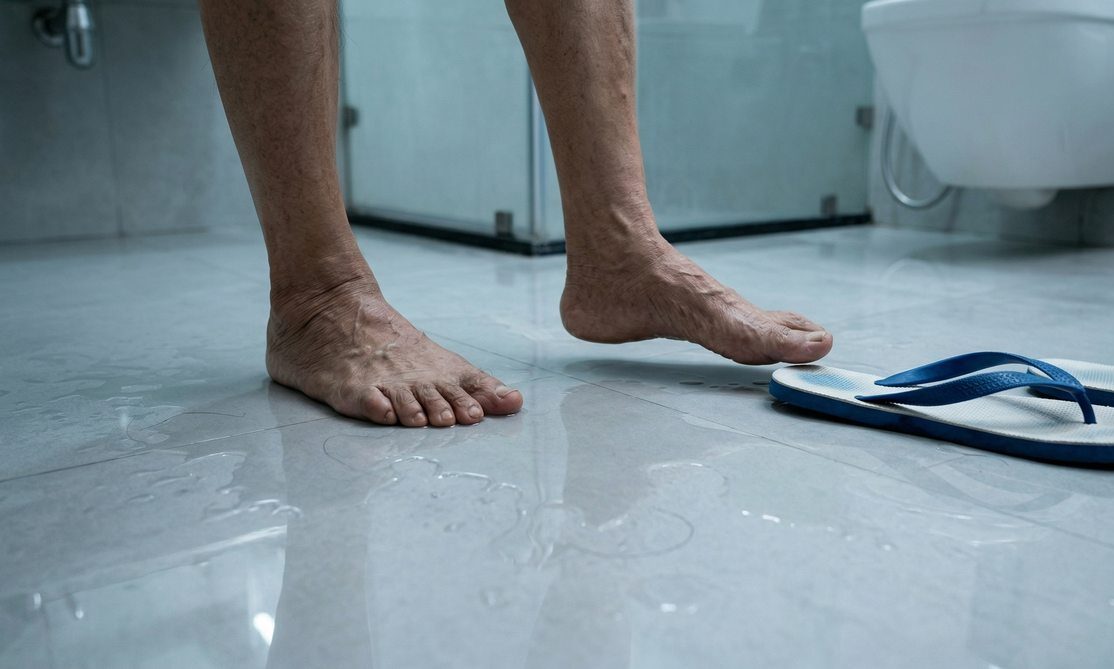
The bathroom is responsible for the highest proportion of serious falls in elderly adults — particularly the transition between standing and sitting on the toilet, the step in and out of the bathtub or shower, and the wet floor immediately after bathing. These are all moments where the person is off-balance and the surface beneath them offers less friction than they expect.
Grab bars are the single most impactful modification for bathroom fall prevention. They should be installed beside the toilet (both sides if possible), inside the shower or at the shower entry, and wherever the person transfers weight. Towel rails are not grab bars — they are not designed to bear full body weight and will pull away from the wall when used for support.
Anti-slip measures include: a non-slip mat inside the shower or bath, a non-slip bathmat outside (with rubber backing that does not slide), anti-slip strips on the floor of the bathtub or shower tray, and — for Indian-style bathrooms — anti-slip tiles or a textured surface treatment on the wet area floor.
A shower chair or bench allows your parent to bathe seated, eliminating the most unstable moments of a standing shower. In Kolkata homes with Indian-style bathrooms, a plastic moulded shower stool is an inexpensive and highly effective modification.
Bathroom Fall Prevention Checklist
- Grab bar installed beside the toilet at the correct height for transfer support
- Grab bar inside shower or at shower entry
- Non-slip mat inside shower or bathtub with suction grip
- Rubber-backed non-slip mat outside shower on wet floor area
- Shower stool or bench available for seated bathing
- Toilet seat raiser if your parent has difficulty standing from a low seat
- Night light inside bathroom that activates automatically in low light
- Hot water temperature set to maximum 48°C to prevent scalding if reflexes are slowed
Staircase Safety
- Handrail on both sides of the staircase if space allows — one handrail means the person has no support for the return journey
- Handrail that extends horizontally at the top and bottom of the stairs, so the person can hold on while stepping on or off the first and last step
- Anti-slip strips on the edge of each step — particularly important on smooth marble or tiled stairs common in Kolkata apartments
- Adequate lighting — a light switch accessible at both the top and bottom of the stairs
- No storage on stairs — not even temporarily
- If your parent can no longer safely negotiate stairs, consider moving the bedroom to the ground floor rather than restricting access
Footwear is the most underestimated fall risk factor in Indian homes.
The bedroom chappals worn in most Kolkata homes — flat, unsupported, and often slightly too large — offer no ankle support and minimal grip. Replacing them with a proper indoor shoe with a closed back, a low non-slip sole, and a slight heel counter is one of the simplest and most effective fall prevention interventions available.
Footwear, Clothing, Exercise, Balance and Medication
Three of the six fall risk factors — footwear, exercise and balance, and medication — are modifiable through behaviour rather than home modification. They are also the factors most often overlooked by families focused on physical changes to the home.
Footwear and Clothing
Indoor footwear should have a closed back (no slip-ons or backless chappals), a low non-slip rubber sole, and a slight heel counter that keeps the foot in place. Sports shoes worn indoors are often appropriate. Long nightdresses, dhoti, and loose pyjamas that trail on the floor are a significant trip hazard — ensure night clothes end above the ankle.
Exercise and Balance
Regular exercise that targets leg strength and balance is one of the most evidence-supported fall prevention interventions. Tai chi, yoga (adapted for the person's mobility level), and targeted physiotherapy exercises all show significant reduction in fall rates in older adults. A physiotherapist assessment identifies the specific exercises appropriate for your parent's current strength and balance level. Even 20 minutes of targeted exercise three times a week produces measurable improvement in 6 to 8 weeks.
Medication Review
Ask your parent's GP for a medication review specifically focused on fall risk. The most common culprits are sedatives and sleeping aids, blood pressure medications that cause orthostatic hypotension (dizziness on standing), diuretics that require urgent trips to the bathroom, and antihistamines that cause sedation. Many elderly patients are on medications prescribed years earlier that have not been reviewed. Reducing or replacing even one medication in this category can significantly reduce fall risk.
Footwear and Clothing
Indoor footwear should have a closed back (no slip-ons or backless chappals), a low non-slip rubber sole, and a slight heel counter that keeps the foot in place. Sports shoes worn indoors are often appropriate. Long nightdresses, dhoti, and loose pyjamas that trail on the floor are a significant trip hazard — ensure night clothes end above the ankle.
Exercise and Balance
Regular exercise that targets leg strength and balance is one of the most evidence-supported fall prevention interventions. Tai chi, yoga (adapted for the person's mobility level), and targeted physiotherapy exercises all show significant reduction in fall rates in older adults. A physiotherapist assessment identifies the specific exercises appropriate for your parent's current strength and balance level. Even 20 minutes of targeted exercise three times a week produces measurable improvement in 6 to 8 weeks.
Medication Review
Ask your parent's GP for a medication review specifically focused on fall risk. The most common culprits are sedatives and sleeping aids, blood pressure medications that cause orthostatic hypotension (dizziness on standing), diuretics that require urgent trips to the bathroom, and antihistamines that cause sedation. Many elderly patients are on medications prescribed years earlier that have not been reviewed. Reducing or replacing even one medication in this category can significantly reduce fall risk.
The Fall Prevention Audit
A fall prevention audit is a structured walk-through of the home that identifies hazards across all six risk categories. It is most effective when done by someone who knows what to look for — a physiotherapist, a trained care manager, or a nurse with geriatric experience — rather than a family member who may overlook risks that have become familiar.
The audit covers every room the person uses, all transition points (doorways, steps, changes in floor level), lighting in all conditions including night-time, and the person’s own behaviour patterns. The output is a prioritised list of modifications — not every possible change, but the changes that will have the most impact on this specific person’s fall risk.
Home Fall Prevention Audit Checklist
☑ Tick what applies to your parent's home. Then screenshot this list and send it to a sibling or caregiver - it's easier to fix things when everyone sees the same gaps.
Flooring: All loose rugs and mats secured or removed. No raised carpet edges. Non-slip treatment on bathroom floors. Clear pathways through all rooms without obstacles.
Lighting: Adequate light in all rooms including night-time. Switches accessible at both ends of corridors and top and bottom of stairs. Motion-activated night lights in bathroom and bedroom-to-bathroom path.
Bathroom: Grab bars installed correctly. Non-slip surfaces in wet area. Shower stool available. Toilet seat height appropriate (add raiser if needed). Night light fitted.
Bedroom: Bed height appropriate — feet should reach the floor when seated on edge. Phone or alarm within reach of the bed. Path to bathroom clear and lit. No items that require the person to stretch or climb.
Staircase: Handrail on at least one side, preferably both. Anti-slip strips on step edges. Light switches at top and bottom. No storage on steps.
General home: Telephone and frequently needed items within easy reach without stretching. No extension cords across pathways. Pets trained not to underfoot. Comfortable, supportive indoor footwear worn consistently.
Flooring: All loose rugs and mats secured or removed. No raised carpet edges. Non-slip treatment on bathroom floors. Clear pathways through all rooms without obstacles.
Lighting: Adequate light in all rooms including night-time. Switches accessible at both ends of corridors and top and bottom of stairs. Motion-activated night lights in bathroom and bedroom-to-bathroom path.
Bathroom: Grab bars installed correctly. Non-slip surfaces in wet area. Shower stool available. Toilet seat height appropriate (add raiser if needed). Night light fitted.
Bedroom: Bed height appropriate — feet should reach the floor when seated on edge. Phone or alarm within reach of the bed. Path to bathroom clear and lit. No items that require the person to stretch or climb.
Staircase: Handrail on at least one side, preferably both. Anti-slip strips on step edges. Light switches at top and bottom. No storage on steps.
General home: Telephone and frequently needed items within easy reach without stretching. No extension cords across pathways. Comfortable, supportive indoor footwear worn consistently.
How Tribeca Care Helps with Fall Prevention
Tribeca Care’s fall risk assessment covers all six risk factors and results in a written report with prioritised recommendations — both the physical modifications and the behavioural and medical actions that will have the greatest impact on your parent’s specific situation. For families who have already experienced a fall, we also provide post-fall care management to reduce the risk of a second fall, which is statistically the most dangerous.
The assessment is carried out at home by a trained care manager and typically takes 60 to 90 minutes. It can be done as a standalone exercise or as part of a broader care assessment if you are also considering ongoing care management support.
Grab bars, anti-slip strips, motion-activated night lights, and other items flagged during a fall risk assessment are available through Tribeca Care’s Senior Safety store, with home delivery across Kolkata.
Get a Fall Risk Assessment for Your Parent
- In-home fall risk assessment across all six risk categories
- Written report with prioritised modification recommendations
- Physiotherapy referral where exercise intervention is indicated
- Post-fall assessment to reduce second-fall risk
✓ This is not an emergency service and not a sales call. If the situation appears low-risk, you'll be told that plainly. You decide what, if anything, to do next. You can opt out at any time.
Frequently Asked Questions
After a first fall, the priority is a medical review (to rule out underlying causes like a cardiac event, blood pressure issue, or new medication interaction) and a home assessment to identify and address the environmental factors. The risk of a second fall in the 12 months following a first fall is significantly elevated, and it is the second fall that most often causes serious injury. Acting in the weeks after a first fall is the highest-leverage window for prevention.
The most evidence-supported programmes are those that combine leg strengthening (chair stands, heel raises) with balance training (single-leg standing, tandem walking). Tai chi has the strongest evidence base of any single activity for fall reduction in older adults. The specific programme should be tailored to your parent’s current strength and mobility level — a physiotherapist assessment is the best starting point. For most parents in Kolkata, a home physiotherapy programme is more practical than attending a class.
Most landlords in Kolkata will agree to grab bar installation if you explain the medical necessity and offer to restore the wall on vacation (or leave the bars as an improvement). Suction-cup grab bars are available as an alternative for smooth tiled walls — they do not require drilling but must be tested regularly for security. For higher-weight users or those with significant balance impairment, wall-mounted bars with proper fixing are strongly preferred. A handyman familiar with bathroom fittings can install these in two to three hours.
After a first fall, the priority is a medical review (to rule out underlying causes like a cardiac event, blood pressure issue, or new medication interaction) and a home assessment to identify and address the environmental factors. The risk of a second fall in the 12 months following a first fall is significantly elevated, and it is the second fall that most often causes serious injury. Acting in the weeks after a first fall is the highest-leverage window for prevention.
The most evidence-supported programmes are those that combine leg strengthening (chair stands, heel raises) with balance training (single-leg standing, tandem walking). Tai chi has the strongest evidence base of any single activity for fall reduction in older adults. The specific programme should be tailored to your parent’s current strength and mobility level — a physiotherapist assessment is the best starting point. For most parents in Kolkata, a home physiotherapy programme is more practical than attending a class.
Most landlords in Kolkata will agree to grab bar installation if you explain the medical necessity and offer to restore the wall on vacation. Suction-cup grab bars are available as an alternative for smooth tiled walls — they do not require drilling but must be tested regularly for security. For higher-weight users or those with significant balance impairment, wall-mounted bars with proper fixing are strongly preferred. A handyman familiar with bathroom fittings can install these in two to three hours.
Need a professional home safety assessment?
Our team can assess your parent's home environment room by room, identify structural risks a checklist won't catch, and create a prioritised safety plan - starting at ₹999.
Book a Home Risk Audit