If you’d like, we can help you assess your parent’s fall-risk readiness and emergency response structure in Kolkata – without assuming that anything has to change today.
Care Guide
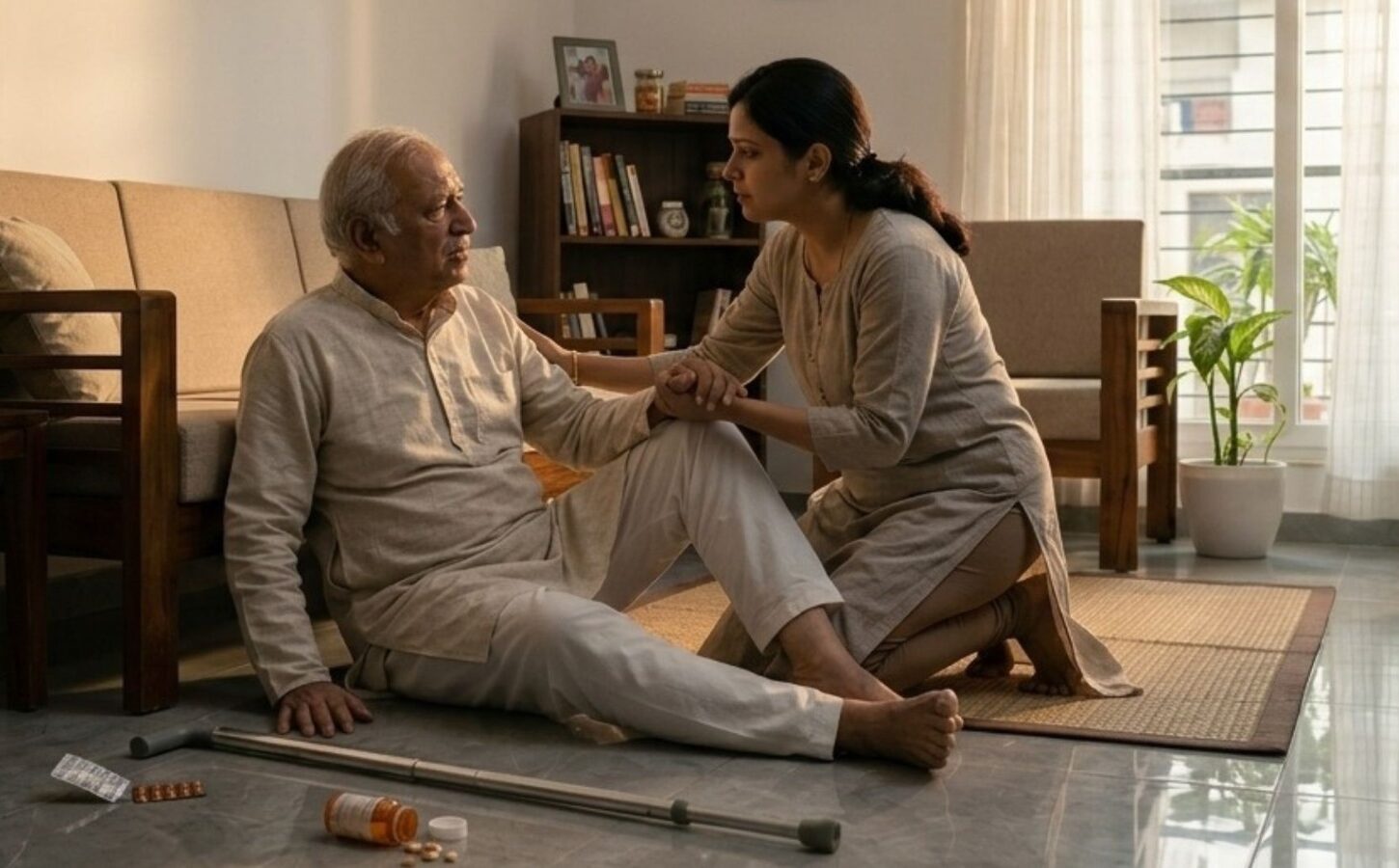
When an Elderly Parent Falls at Home: What to Do in the First 60 Minutes
Falls are the leading cause of injury-related hospitalisation in adults over 65 in India, and in Kolkata, most happen inside the home between 10 pm and 6 am when no one is immediately present. If you are reading this from another city – or because it nearly happened recently – this TribecaCare guide covers what to do in the first 60 minutes and what a fall reveals about the gaps in your parents’ current care structure. Read it fully to learn more on What to Do in the First 60 Minutes when an elderly parent falls at home.
Falls & Safety — Has a fall occurred, and does the family know? Informed by clinical falls risk stratification, including the Tinetti POMA
How a fall actually unfolds
The call comes at 11pm. Or sometimes it’s not a call at all – it’s a WhatsApp message from the domestic help, half in Bengali, half-panicked: “Dadu porhe gechhe. Floor e.”
If you’re in the same city, you’re in an auto within minutes, heart racing, trying to call your father’s phone which rings and rings. If you’re in London or Singapore or Dubai, you’re staring at your phone at 5am, fragments of messages from different people, none of whom have the full picture. Your mother is calling the neighbour. The help is calling you. Nobody has called a doctor yet.
This is how it happens for most families. Not dramatically – chaotically. And the chaos is the problem. Because in the first 30 minutes after an elderly parent falls at home, the family’s response system is tested, and most families discover they don’t actually have one.
What most families discover after a fall
It's rarely a lack of love. It's a lack of structure. Nobody knew for hours. Nobody had the doctor's number saved. Nobody was sure whether to move them or not. Five people had partial information and no one had the whole picture. The fall didn't cause the crisis - it revealed the gaps that were already there.
The first 60 minutes – what to actually do
If your parent has just fallen, or you’ve just received the call, here is what matters right now. Not everything. Just what matters.
If you are physically present
- Do not rush to lift them up. If there’s any chance of a hip fracture or spinal injury, moving them incorrectly can make it dramatically worse. If they’re conscious, ask where the pain is. If they can’t bear weight on a leg, assume fracture.
- Call the doctor, not just the ambulance. Your family physician can advise over the phone whether this needs an ER visit or can be managed at home. If you don’t have a family doctor on speed dial – that itself is a gap worth noting.
- Check for head injury signs. Confusion beyond what’s normal, vomiting, unequal pupils, or losing consciousness – even briefly – means hospital, not home assessment.
- If they seem okay, help them to a chair slowly. Apply ice to any swelling. Watch them for the next 4-6 hours for delayed symptoms. Falls in the elderly can cause internal bleeding that doesn’t show immediately.
If you are not there - the remote response
- Identify who is closest. Not who is most worried – who can physically reach your parent fastest. Call them. Give them clear instructions, not emotional reactions.
- Get a visual. Ask someone to video-call you. You can assess the situation far better than through panicked voice descriptions.
- Resist the urge to call everyone simultaneously. Designate one point person. Have them update a WhatsApp group. Multiple people calling your parent’s phone while they’re on the floor is not helpful.
- Know the hospital. Which hospital is closest? Which one does the family doctor have admitting privileges at? If you don’t know the answer, you’ll waste 20 minutes finding out when those 20 minutes matter.
The question that reveals everything
Ask yourself: if something happened at 2am tonight, who would know first? If the answer is “nobody, until morning” – that’s not a fall-prevention problem. That’s a supervision architecture problem. And no grab bar fixes that.
What a fall actually reveals
A fall is not just a physical event. It is a diagnostic event. It reveals how your family’s care structure actually works – or doesn’t – under pressure. Most families discover four specific gaps:
The detection gap
How long between the fall and someone knowing? If your parent lives alone, or with an elderly spouse who was asleep, the gap can be hours. Your mother might have been on the bathroom floor from midnight until the help arrived at 7am. Nobody detected it. This is the gap that monitoring systems, fall detection devices, and night-time supervision are designed to close.
The decision gap
Once someone knows, who decides what to do? The help doesn't know whether to call the ambulance or wait. Your mother wants to "just rest." Your brother thinks it's fine. You think it's not. Nobody has pre-agreed authority to make the call. In the minutes that matter, the family negotiates instead of acting.
The action gap
Someone decides "hospital" - but who physically takes them? The helper can't lift your father. The neighbor has come but doesn't have a car. The ambulance takes 40 minutes depending on traffic and time of day. The gap between "we've decided" and "someone is doing something" is where outcomes diverge.
The communication gap
And through all of this - who knows what? Your sister in Mumbai got a call from the help. You got a message from your mother. Your brother didn't pick up his phone. The doctor was told one thing, the hospital another. By the time everyone has the same information, the critical window has passed. Information travels through the family like a game of telephone, and each relay adds distortion.
Most families don't fail because they don't care. They fail because the structure around care doesn't match the reality of what aging actually demands.
What to change before the next fall
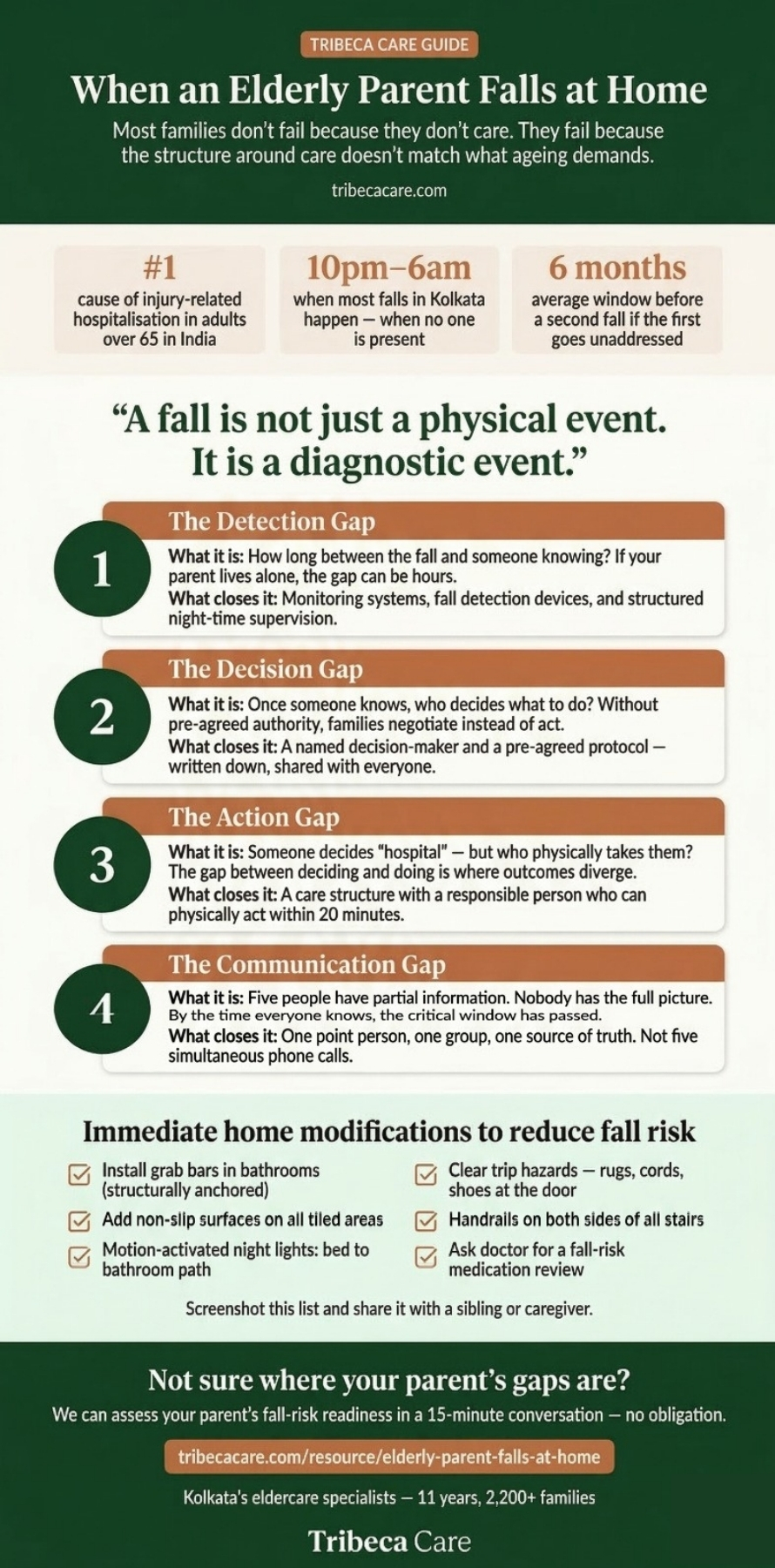
Immediate home modifications
☑ Tick what applies to your parent's home. Then screenshot this list and send it to a sibling or caregiver - it's easier to fix things when everyone sees the same gaps.
Install grab bars in bathrooms – near the toilet and inside the shower area. These must be structurally anchored into wall studs, not surface-mounted. A grab bar that pulls out of the wall during a fall is worse than no grab bar.
Add non-slip surfaces – anti-skid strips or mats in bathrooms, kitchens, and any tiled area that gets wet. Replace loose cotton rugs with rubber-backed alternatives or remove them entirely.
Fix the lighting – motion-activated night lights in hallways, bathrooms, and bedrooms. The path from bed to bathroom at 3am should never require reaching for a switch in the dark.
Clear the clutter – newspapers on the floor, shoes at the door, trailing electrical cords. Every obstacle is a trip hazard. Walk through the home at your parent’s height and pace, not yours.
Secure the stairs – handrails on both sides, even illumination, no loose carpet. If mobility is declining, consider whether the bedroom should move to the ground floor.
Review medications – many common medications for blood pressure, sleep, and anxiety increase fall risk. The WHO’s report on medication safety in polypharmacy recommends structured medication review at every care transition. Ask the doctor specifically for a fall-risk medication review. This is often the highest-impact single intervention.
When modifications aren’t enough
Sometimes you can install every grab bar, replace every rug, and add lights to every corridor – and the falls still happen. Or your parent refuses the modifications. Or the help isn’t trained to respond correctly. Or there’s simply nobody there at 2am.
This is when the problem shifts from home safety to supervision architecture. Functional assessment tools like the Katz ADL Index measure independence across bathing, dressing, toileting, transferring, continence, and feeding — and when those start declining, the question changes from “is the home safe?” to “is someone watching, deciding, and acting when I can’t be there?”
A professional home risk audit goes beyond what a family can spot. It assesses structural load capacity for grab bars, clinical-grade placement based on the person’s specific reach and grip strength, wheelchair turning radius requirements, lighting levels measured in lux, and creates a prioritised remediation plan. It’s the difference between a checklist and a diagnosis.
Check your parents' fall risk — takes 3 minutes
What happens next:
- A care coordinator reaches out within 48 hours
- 15-minute structured conversation about your parent’s current setup
- We cover: Detection, Decision, Action, and Communication gaps
- You get a clear assessment of vulnerabilities and priorities
The TCRI assesses five domains drawn from established geriatric frameworks including the Katz ADL Index, Tinetti POMA, and WHO medication review guidelines. How it works →
✓ This is not an emergency service and not a sales call. If the situation appears low-risk, you'll be told that plainly. You decide what, if anything, to do next. You can opt out at any time.
Frequently Asked Questions
How long between the fall and someone knowing? If your parent lives alone, or with an elderly spouse who was asleep, the gap can be hours. Your mother might have been on the bathroom floor from midnight until the help arrived at 7am. Nobody detected it. This is the gap that monitoring systems, fall detection devices, and night-time supervision are designed to close.
Once someone knows, who decides what to do? The help doesn’t know whether to call the ambulance or wait. Your mother wants to “just rest.” Your brother thinks it’s fine. You think it’s not. Nobody has pre-agreed authority to make the call. In the minutes that matter, the family negotiates instead of acting.
Someone decides “hospital” – but who physically takes them? The helper can’t lift your father. The neighbor has come but doesn’t have a car. The ambulance takes 40 minutes depending on traffic and time of day. The gap between “we’ve decided” and “someone is doing something” is where outcomes diverge.
And through all of this – who knows what? Your sister in Mumbai got a call from the help. You got a message from your mother. Your brother didn’t pick up his phone. The doctor was told one thing, the hospital another. By the time everyone has the same information, the critical window has passed. Information travels through the family like a game of telephone, and each relay adds distortion.
Need a professional home safety assessment?
Our team can assess your parent's home environment room by room, identify structural risks a checklist won't catch, and create a prioritised safety plan - starting at ₹999.
Book a Home Risk AuditThere is no perfect solution. There is only the next honest decision, made with the information you have at the time.
