We can arrange a structured home safety assessment through Tribeca Life Systems — a trained assessor who identifies hazards, recommends specific modifications, and produces a prioritised report for your family.
Care Guide
Home Safety Assessment for Elderly Parents in Kolkata: Room-by-Room Guide
Most home accidents involving elderly parents happen in rooms that have not been assessed for safety in years. The hazards are ordinary — a loose rug, a dark corridor, a bathroom without support. This guide helps you identify what needs to change, room by room, before something happens.
Why Most Home Accidents Are Preventable
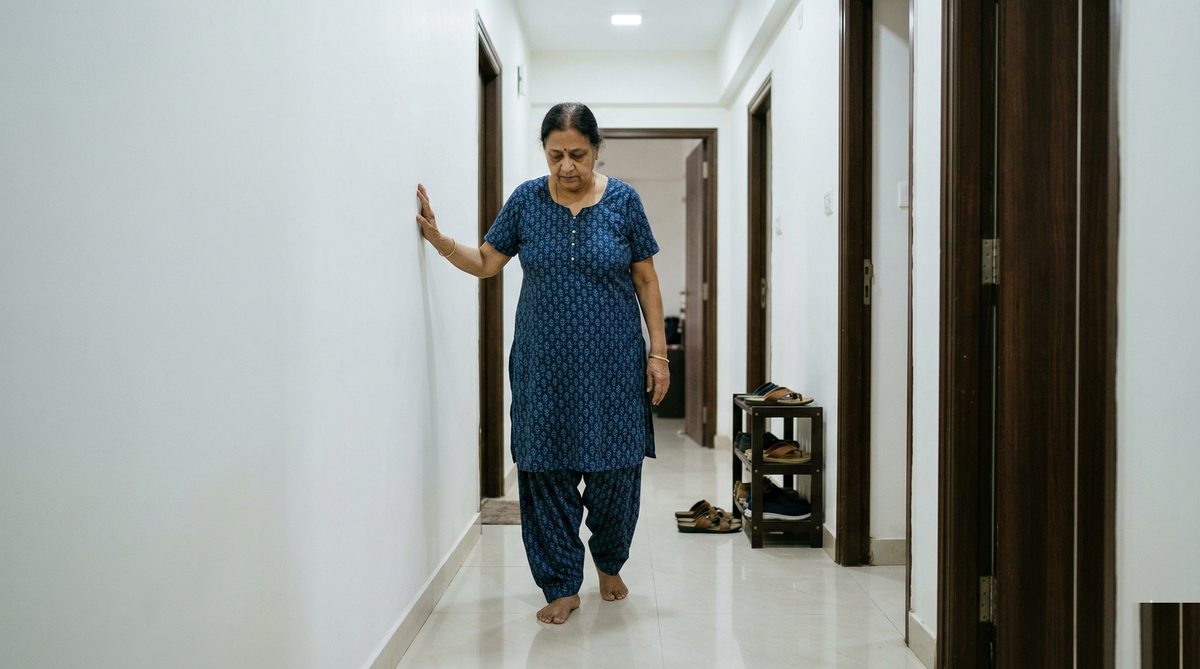
A family that walks through their elderly parent’s home with fresh eyes finds hazards they had stopped seeing — a loose cotton mat in the corridor, a bathroom without a single grab bar, a light switch positioned so that the path to the bathroom at 3am is walked in darkness.
Falls do not happen because elderly people are careless. They happen because the home environment has not been adapted to how an ageing body moves and balances. The majority of fall hazards are visible, fixable, and inexpensive to address. The challenge is knowing what to look for before a fall makes the audit urgent rather than preventive.
Most home accidents reveal hazards the family had stopped seeing
This assessment is not about making the home look different. It is about removing the small risks that accumulate silently until one of them becomes an emergency.
Bathroom and Toilet Safety
The bathroom is the site of the majority of elderly home accidents in India. Wet surfaces, low toilet seats, the absence of support rails, and slippery bathing areas are the primary contributors — and all of them are addressable. A bathroom that has been assessed and modified for an elderly person looks almost identical to a standard bathroom. The differences are structural anchors, surface treatments, and seat heights that take minutes to notice and a morning to install.
Bathroom safety checklist
- Grab bar beside the toilet, anchored into wall studs — not adhesive-mounted. Test with full body weight before relying on it.
- Grab bar inside the shower or bath area, positioned to support lowering and rising, not just balance.
- Non-slip mat inside the shower and immediately outside it. Replace regularly — worn suction cups fail silently.
- Raised toilet seat if your parent cannot stand from standard toilet height without forward momentum or assistance.
- Shower chair or bath bench for anyone whose balance or stamina makes standing through a full shower unsafe.
- All daily items within easy reach — no bending below knee height or reaching above shoulder height.
Bedroom and night-time movement checklist
- Motion-activated night light on the path from bed to bathroom, activating at floor level.
- Bed at correct height — feet flat on the floor when sitting on the edge. Too low makes standing dangerous; too high increases fall risk getting out.
- Grab rail or bed rail on the exit side, particularly if there is one-sided weakness or reduced core strength.
- Clear path with no obstacles — no shoes at the bed’s edge, no newspapers or cords crossing the room.
- Phone within reach from the sleeping position, always charged. If your parent falls and cannot reach their phone, the gap between fall and discovery can be hours.
If your parent fell tonight and could not reach their phone from where they land — how long before someone knew? If the answer involves waiting for the morning help, that is a gap worth closing today.
Kitchen, Staircase, Lighting and Flooring
The remaining high-risk areas in most Kolkata homes are the kitchen, the staircase, the corridor lighting, and the flooring throughout. Each presents a distinct category of hazards and a distinct set of fixes.
Kitchen
Kitchens present three risk categories: wet floors from cooking and washing, stored items at heights requiring bending or reaching, and heat sources that cause burns when balance is compromised. Move items stored above shoulder height to a lower shelf. Install a non-slip mat in front of the sink. Ensure cooker knobs are clearly marked. If cognitive decline is a concern, automatic gas shut-off devices are worth installing.
Staircase
Handrails on both sides of every staircase, continuous from top to bottom without gaps. Even lighting with no steps in shadow. No carpet lifting at the edges. Non-slip strips on any polished or tiled stair surface. If stairs are a daily route and balance is declining, consider moving the bedroom to the ground floor — the modification cost is almost always lower than the consequence of a staircase fall.
Lighting
Test each room: can your parent reach the light switch without moving through a dark space? Corridors, bathrooms and staircases require adequate lighting at all hours. Motion sensors remove the need to find switches entirely. Older eyes require substantially more light to see clearly than younger ones — rooms that appear well-lit in daylight are often significantly dimmer at night.
Flooring
Polished marble and tile in wet areas are the highest-risk flooring in Indian homes. Anti-skid treatments can be applied to existing flooring without replacement. Loose cotton rugs — common in Bengali households — should be removed or replaced with rubber-backed alternatives. Any rug that moves when walked on is a fall risk. Doorway thresholds above 1cm are a trip hazard for anyone using a walking frame or whose gait does not fully clear the floor.
The Home Safety Checklist
Use this checklist as a systematic walkthrough. Mark each item as addressed, not needed, or action required. Prioritise action-required items involving the bathroom, night-time movement path, and staircase access first — these produce the highest return per rupee of investment.
Priority safety modifications
☑ Tick what applies to your parent's home. Then screenshot this list and send it to a sibling or caregiver - it's easier to fix things when everyone sees the same gaps.
Bathroom grab bars installed and structurally anchored — test with full body weight. A grab bar that pulls out during a fall is more dangerous than no grab bar at all.
Non-slip surfaces in bathroom and kitchen — inside the shower, outside the shower, and in front of the sink at minimum.
Night lighting on path from bed to bathroom — motion-activated, at floor level, no dark segments on the route.
All loose rugs removed or rubber-backed — if it moves when you walk on it, it is a fall risk.
Staircase handrails on both sides, continuous, with even lighting on all treads.
Medication review requested from the doctor — ask specifically about fall risk from current medications. This is frequently the highest-impact single intervention and the most commonly overlooked.
When a Family Checklist Is Not Enough
A family walkthrough is a good starting point. A professional home safety audit goes further: it assesses structural load capacity for grab bar installation, clinical placement based on your parent’s specific reach and grip strength, wheelchair turning radius requirements if mobility aids are in use, lighting levels measured in lux, and produces a prioritised remediation plan.
It is the difference between a checklist and a diagnosis. If your parent has already had a fall, or if significant mobility decline is present, a professional assessment reduces the risk of missed hazards and — critically — misinstalled equipment, which can be more dangerous than nothing at all.
Many of the items that come up in a home safety assessment — grab bars, anti-slip mats, raised toilet seats, motion-activated night lights — are available through Tribeca Care’s Senior Safety store, with home delivery across Kolkata.
Would you like a home safety assessment for your parent in Kolkata?
- A care coordinator reaches out within 48 hours
- Structured conversation about your parent’s current mobility and home layout
- Assessment covers: bathroom, bedroom, kitchen, staircase, lighting and flooring
- You receive a clear report of hazards and priority modifications
✓ This is not an emergency service and not a sales call. If the situation appears low-risk, you'll be told that plainly. You decide what, if anything, to do next. You can opt out at any time.
Frequently Asked Questions
A home safety assessment is a systematic walkthrough of your elderly parent’s home to identify fall hazards and environmental risks. It covers the bathroom, bedroom, kitchen, staircase, lighting and flooring, and produces a prioritised list of modifications. It can be done by a family member using a checklist or by a trained professional who assesses structural, clinical, and environmental factors.
The bathroom causes the majority of elderly home accidents in India. Wet surfaces, absence of grab bars, low toilet seats, and slippery bathing areas are the primary contributors. The night-time path between the bedroom and bathroom is the second-highest-risk zone, particularly for those who wake in the dark and move without switching on lights.
The most impactful modifications — grab bars, non-slip mats, motion-activated night lights, and removal of loose rugs — typically cost between ₹3,000 and ₹15,000 for a standard Kolkata apartment, depending on the number of bathrooms and how much work needs to be done. A professional home safety audit that identifies exactly what is needed typically costs significantly less than one hospital admission from a preventable fall.
Need a professional home safety assessment?
Our team can assess your parent's home environment room by room, identify structural risks a checklist won't catch, and create a prioritised safety plan - starting at ₹999.
Book a Home Risk Audit