Whether you are in Bangalore, Boston, or Bahrain, we will map your parent’s current care situation and identify the gaps. A structured assessment, a written plan, and a care manager you can reach by phone.
Care Guide
Managing Elderly Parents in Kolkata When You Are Not There: A Guide for NRB and NRI Families
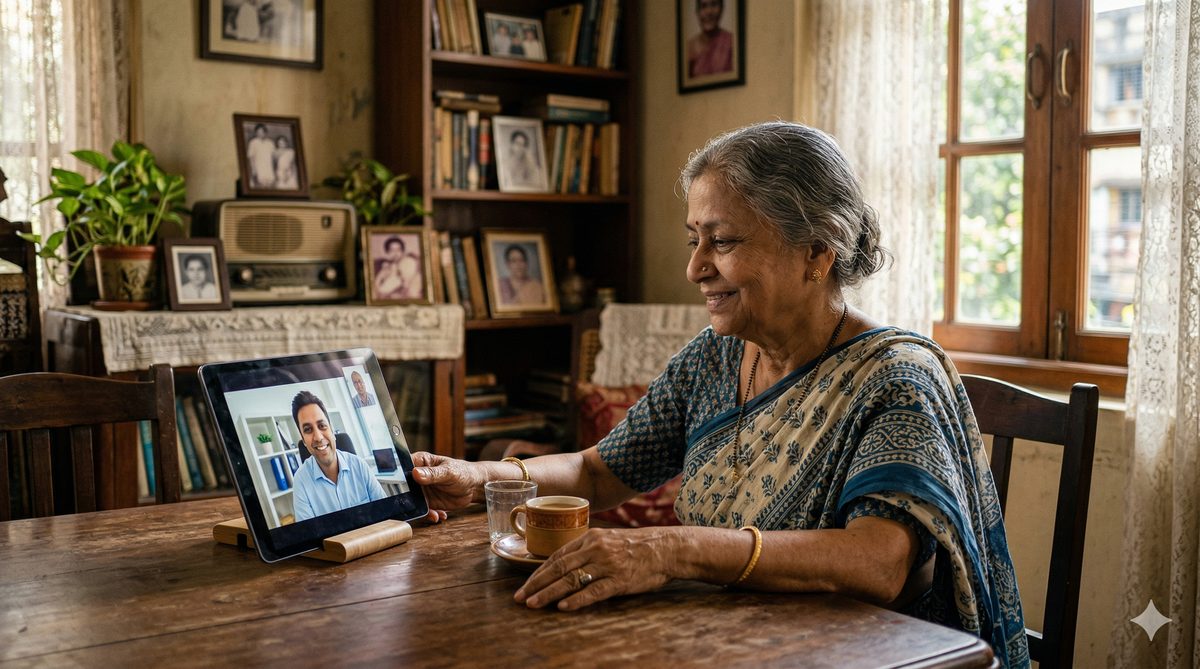
Managing Elderly Parents in Kolkata When You Are Not There: A Guide for NRB and NRI Families
Most NRI and NRB families manage their elderly parents in Kolkata through phone calls, trusted relatives, and a lot of hope. When a crisis happens — a fall, a hospitalisation, a sudden decline — the distance becomes brutal. This page is for families who want to replace that uncertainty with a care structure that actually works, from wherever they are in the world.
The good news: distance is a solvable problem. The bad news: most families only discover the solution after the first crisis.
Managing Elderly Parents in Kolkata When You Are Not There: A Guide for NRB and NRI Families
An estimated 3 to 4 million Bengalis live outside Kolkata — in Bangalore, Mumbai, Delhi, Hyderabad, and abroad — and most are managing the care of elderly parents without being physically present. Whether you are in Bandra or Boston, the structural problems are the same: detection gaps, decision lag, and the knowledge that when something happens, you cannot be there within the hour.
The Three Failures That Bring Distance Families to Crisis
Most distance care arrangements break down in one of three ways. First, there is the detection failure — no one notices the gradual decline because everyone assumes someone else is watching. A domestic helper sees the parent daily but is not trained to identify early warning signs. Neighbours notice but do not want to intrude. By the time the adult child visits, the decline has been accumulating for months.
Second, there is the decision failure — when something does happen, the family member who is present (often a neighbour, domestic helper, or a distant relative) does not know who to call or what to authorise. Calls go back and forth between the adult child abroad and various people on the ground, losing critical time. Decisions are delayed because no one has clear authority.
Third, there is the coordination failure — even when the family identifies a solution (hire a nurse, arrange a hospital visit, install a grab bar), there is no one locally to actually make it happen. The adult child can research and pay from a distance, but execution requires physical presence.
The problem is not love or intention — it is structure.
Distance families who manage care well have built a local support structure with clear roles, escalation paths, and a trusted person who can act on their behalf within the hour.
NRB Families: When You Are Three Hours Away but Still Not There
For families in Bangalore, Mumbai, Delhi, or Hyderabad, the distance feels manageable — you can be in Kolkata in three hours by flight. In practice, this creates a false sense of security. The average time from “something has happened” to an adult child landing in Kolkata is 6 to 12 hours, even under the best circumstances. That is a long time for an elderly parent to be in a precarious situation with no structured support.
The NRB pattern typically involves: a domestic helper who manages day-to-day needs, a driver who can take the parent for appointments, and an informal network of relatives and neighbours who serve as a social safety net. This arrangement works under normal conditions and breaks down entirely in a health crisis, a fall, or a period of significant cognitive decline.
What NRB families need is not more frequent visits — it is a care structure that functions between visits. This means a trained care manager who sees the parent regularly and reports back, a clear escalation protocol that bypasses the confusion of who to call, and the ability to authorise decisions remotely without being on six simultaneous phone calls.
NRB Family Care Structure Checklist
- A named care manager who visits the parent at least twice a week
- Written reports shared after each visit via WhatsApp or email
- A clear escalation contact who can be reached at any hour
- Pre-authorisation for defined medical decisions (GP visit, pharmacy, physiotherapy)
- A nominated local family member or trusted person who can act for higher-stakes decisions
- Emergency protocol document kept in the home and shared digitally with all key people
What to Put in Your Monthly Check-In Call
- Current medication status and recent GP interactions
- Mobility observations — any new stiffness, falls, or near-falls
- Cognitive observations — confusion, memory gaps, personality changes
- Nutrition and hydration — is the parent eating and drinking adequately
- Social engagement — isolation, withdrawal, or mood changes
- Domestic situation — is the helper showing up, are bills being paid, is the home maintained
The time zone gap is real — but it is a solvable problem.
NRI families who manage elder care well have one thing in common: a trusted local partner who can observe, escalate, and act — not just report. The difference between a helpline and a care manager is the difference between information and action.
NRI Families: Building a Care Structure Across Time Zones
For families in the US, UK, Europe, Australia, or the Gulf, the distance calculation is fundamentally different. A health crisis in Kolkata at 3am IST is 9pm the previous evening in London and 5pm in New York. You will be awake and reachable — but you are 8,000 miles away and cannot be there for 24 to 48 hours minimum. Every decision must be made remotely, with incomplete information, through intermediaries you may not fully trust.
The NRI care structure needs to solve for three things: observation (someone who sees the parent regularly and notices change), escalation (a trusted person who can act within the hour in a crisis), and continuity (a care model that does not depend on any single person being available).
Observation: Who Watches When You Cannot
A trained care manager who visits regularly, uses a structured assessment checklist, and reports to you in writing after each visit. Not a neighbour checking in occasionally, and not a domestic helper who has not been trained to identify clinical warning signs.
Escalation: Who Acts When You Cannot
A named individual in Kolkata — ideally your care manager or their organisation — who has pre-authorisation to take defined actions: call an ambulance, take the parent to a specific hospital, contact specific doctors. This person must be reachable at any hour and have a relationship with your parent before a crisis, not during one.
Communication: Structure Over Ad Hoc Calls
A scheduled weekly video call with your parent, a fortnightly written report from the care manager, and a clear protocol for what constitutes an emergency call (versus a WhatsApp update). Remove the ambiguity about when to contact you and how.
Observation: Who Watches When You Cannot
A trained care manager who visits regularly, uses a structured assessment checklist, and reports to you in writing after each visit. Not a neighbour checking in occasionally, and not a domestic helper who has not been trained to identify clinical warning signs.
Escalation: Who Acts When You Cannot
A named individual in Kolkata — ideally your care manager or their organisation — who has pre-authorisation to take defined actions: call an ambulance, take the parent to a specific hospital, contact specific doctors. This person must be reachable at any hour and have a relationship with your parent before a crisis, not during one.
Communication: Structure Over Ad Hoc Calls
A scheduled weekly video call with your parent, a fortnightly written report from the care manager, and a clear protocol for what constitutes an emergency call (versus a WhatsApp update). Remove the ambiguity about when to contact you and how.
Choosing a Care Manager vs a Call Centre
The distance care market in India has grown significantly in the past decade, and the options range from genuine care management to glorified telephone helplines. Before you engage any service, ask three questions.
First: does someone physically visit your parent, or is the service entirely phone-based? Phone-based services have a role, but they cannot detect physical decline, observe the home environment, or build the kind of relationship that makes a parent genuinely cooperative with care. Physical presence matters.
Second: what happens in a crisis at 2am? Is there a person available to act — not just a call centre that takes notes and tells you to call back in the morning? Test this before you commit.
Third: what is the reporting structure? You need written observations after each visit, not just a phone call that you cannot refer back to. Written reports create continuity and allow you to track change over time.
A care manager from a professional organisation differs from an agency-placed attendant in a critical way: the care manager’s primary relationship is with the family — including the adult child abroad — not just with the parent. They are your eyes and ears, not just a support worker for your parent.
Emergency Protocols When You Cannot Get There Quickly
☑ Tick what applies to your parent's home. Then screenshot this list and send it to a sibling or caregiver - it's easier to fix things when everyone sees the same gaps.
Prepare a one-page emergency information sheet — doctor names and numbers, hospital preference, blood group, known allergies, current medications, and insurance details — and place it physically in the home and share digitally with all key contacts.
Identify and brief two local contacts (not just one) who can respond within 30 minutes: one for daytime and one available at night. Make sure both have a key or know how to access the home.
Pre-select a hospital and establish a relationship with a GP who knows your parent — not just a name on a list, but someone who has met your parent and has a record. Emergency situations at an unfamiliar hospital are significantly harder to manage from a distance.
Establish a clear decision tree: what can your local contact decide independently, what requires your approval, and what should be escalated immediately to your care manager? Write this down and share it.
Set up a notification system — this could be a daily WhatsApp check-in from the domestic helper, a weekly call from the care manager, or a simple morning and evening message that confirms everything is normal. No news is not good news; silence is a warning sign.
Consider a medical alert device for parents who live alone or who have mobility issues — a simple wearable or button-press alert that connects to a monitoring centre gives your parent agency in a crisis and gives you a degree of remote visibility.
Prepare a one-page emergency information sheet — doctor names and numbers, hospital preference, blood group, known allergies, current medications, and insurance details — and place it physically in the home and share digitally with all key contacts.
Identify and brief two local contacts (not just one) who can respond within 30 minutes: one for daytime and one available at night. Make sure both have a key or know how to access the home.
Pre-select a hospital and establish a relationship with a GP who knows your parent — not just a name on a list, but someone who has met your parent and has a record. Emergency situations at an unfamiliar hospital are significantly harder to manage from a distance.
Establish a clear decision tree: what can your local contact decide independently, what requires your approval, and what should be escalated immediately to your care manager? Write this down and share it.
Set up a notification system — this could be a daily WhatsApp check-in from the domestic helper, a weekly call from the care manager, or a simple morning and evening message that confirms everything is normal. No news is not good news; silence is a warning sign.
Consider a medical alert device for parents who live alone or who have mobility issues — a simple wearable or button-press alert that connects to a monitoring centre gives your parent agency in a crisis and gives you a degree of remote visibility.
What Tribeca Care Does for Outstation and NRI Families
Tribeca Care works with more than 400 outstation and NRI families across its 2,200 member household network in Kolkata. The service is built specifically for families who cannot be present: care managers visit regularly, written reports are shared after every visit, and a dedicated family liaison is available by WhatsApp and phone during Indian business hours.
For NRI families, we offer a Distance Care Assessment — a structured conversation that maps the current care arrangement, identifies the gaps, and proposes a support structure matched to the level of risk and complexity. Most families find that a combination of regular care management visits and a clear escalation protocol resolves the core anxiety of being far away.
If your parent is currently being managed by a domestic helper, a neighbour network, and periodic visits from you — and you want to build something more structured — the assessment is the right starting point. It takes 45 minutes and gives you a written action plan.
If you’re based outside Kolkata and want to understand exactly how Tribeca Care structures care for outstation and NRI families, the NRI eldercare service page covers what is included, how reporting works, and how to get started without being in the city yourself.
Get a Distance Care Assessment for Your Parent in Kolkata
- Regular care manager visits with written reports
- 24-hour emergency escalation protocol
- Family liaison available on WhatsApp
- Dedicated point of contact who knows your parent
✓ This is not an emergency service and not a sales call. If the situation appears low-risk, you'll be told that plainly. You decide what, if anything, to do next. You can opt out at any time.
Frequently Asked Questions
Yes. A significant portion of our families are NRI households — based in the US, UK, Europe, Australia, and the Gulf — who manage their parent’s care in Kolkata entirely remotely. We coordinate all communication by WhatsApp, email, and scheduled calls, and ensure that a named care manager and escalation contact are available locally at all times.
The Distance Care Assessment can be done entirely by phone or video call. We speak with you, gather information about your parent’s current situation, and can arrange an in-person assessment of your parent’s home and health status as a separate step. Most families in this situation are operational within one to two weeks of the initial call.
This is the question we get most often. Our emergency protocol for outstation and NRI families includes a designated escalation contact who can be reached at any hour, a pre-defined decision tree that authorises specific actions without requiring your approval (calling an ambulance, going to a specified hospital), and immediate notification to you by phone regardless of time zone. The protocol is set up before anything happens, not during a crisis.
Yes. A significant portion of our families are NRI households — based in the US, UK, Europe, Australia, and the Gulf — who manage their parent’s care in Kolkata entirely remotely. We coordinate all communication by WhatsApp, email, and scheduled calls, and ensure that a named care manager and escalation contact are available locally at all times.
The Distance Care Assessment can be done entirely by phone or video call. We speak with you, gather information about your parent’s current situation, and can arrange an in-person assessment of your parent’s home and health status as a separate step. Most families in this situation are operational within one to two weeks of the initial call.
This is the question we get most often. Our emergency protocol for outstation and NRI families includes a designated escalation contact who can be reached at any hour, a pre-defined decision tree that authorises specific actions without requiring your approval (calling an ambulance, going to a specified hospital), and immediate notification to you by phone regardless of time zone. The protocol is set up before anything happens, not during a crisis.
Need a professional home safety assessment?
Our team can assess your parent's home environment room by room, identify structural risks a checklist won't catch, and create a prioritised safety plan - starting at ₹999.
Book a Home Risk Audit