Care is not a response. It is a system.
What families managing elderly parents in Kolkata from a distance get wrong, and what one man’s bathroom floor taught his son about the only kind of planning that matters.
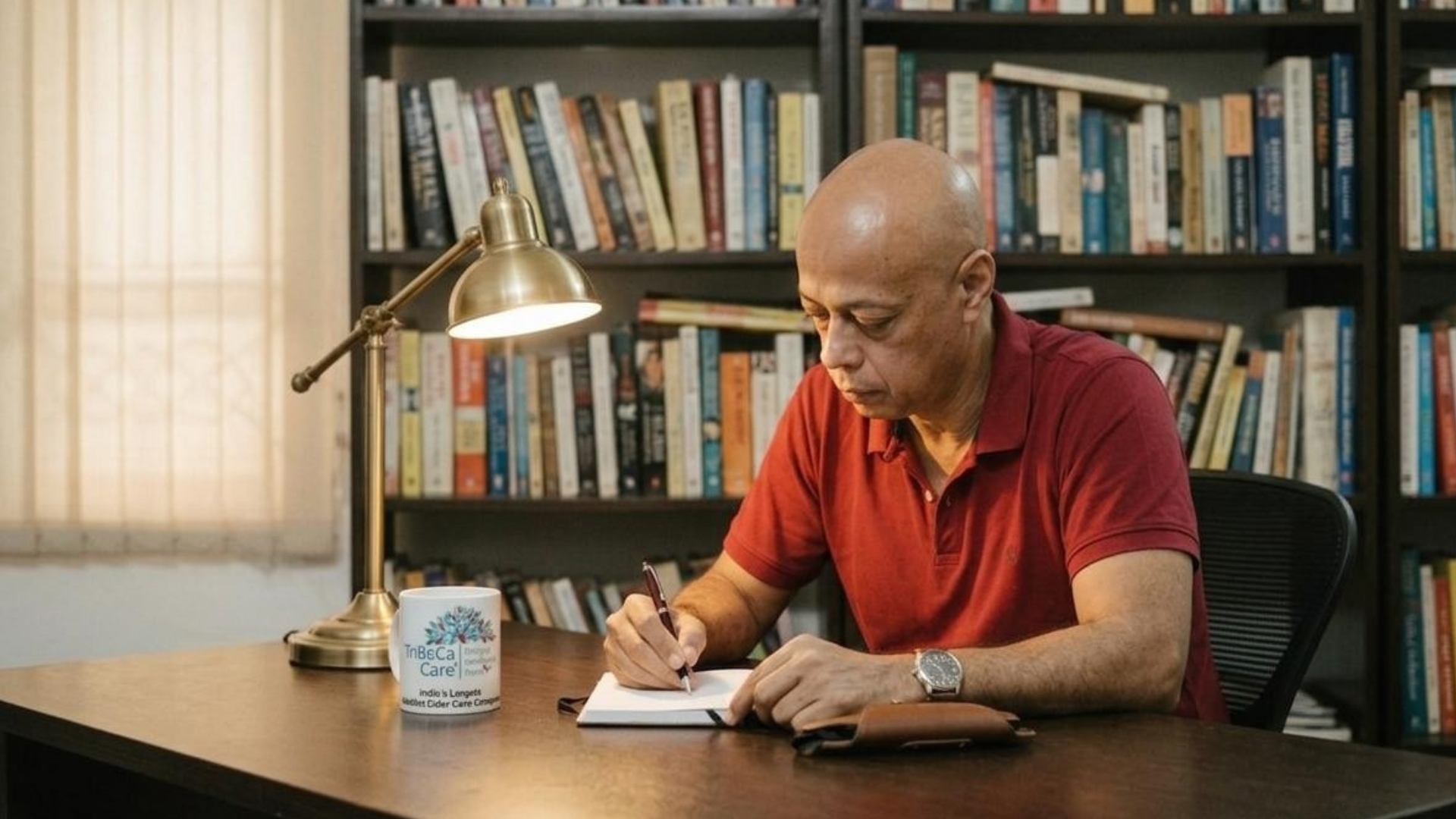
The night the plan failed: a Ballygunge flat, a Wednesday in January
Subrata Ghosh built things.
He built a career from nothing. Started as a junior clerk in a Burrabazar trading house in the early seventies, worked his way up through stubbornness and an ability to read people that Arjun, his son, spent his entire childhood trying to understand. He bought the flat in Ballygunge when the locality was still unfashionable, paid it off in eleven years, and never borrowed again after that. He held the family together through his wife’s long illness in a way that, looking back, Arjun could only describe as matter-of-fact. There was no drama about it. It was just what was required, so it was done.
He was the kind of father whose approval, when it came, felt like something you had genuinely earned. Arjun is now forty-three, senior manager at a company in Bangalore, two kids in good schools. By any external measure, his life has exceeded his father’s. He will tell you himself that none of it changed the basic fact: Subrata Ghosh was the standard he measured himself against. Still is.
On a Wednesday evening in January, Subrata Ghosh slipped getting out of the bathroom.
No fracture, as it turned out. But he couldn’t get up.
He lay on the cold floor for fourteen hours. At some point in the night, he lost control of his bladder. He knew it had happened. He tried to clean himself, slowly, carefully, working on the floor, and couldn’t manage it. This is a man who had never asked anyone for help with anything in his adult life. Who would have found the idea of this moment unbearable to think about.
He lay there in the dark, in the wet, and waited for morning.
Raju found him when he arrived early the next day.
I’ve thought about that night many times since Arjun told me. Not the fall, not the hospital that followed. That night specifically. The man who built the flat, built the family, built the son, alone on a bathroom floor, trying to hold onto some piece of his dignity, with nothing in place that could have reached him any sooner.
That is what the absence of a plan actually costs. Not the inconvenience. Not the hospital bill. That night.
What “we have it covered” looks like from the outside
What happened in the six hours after Raju found him matters too, if only because it shows what “everything is fine” looks like from a distance.
Raju called Arjun. Arjun called the neighbours. The neighbours called an ambulance. The ambulance arrived and asked which hospital. Nobody knew. Dr. Bose had retired two years ago and nobody had got around to finding someone new. Arjun called his aunt in Lake Gardens, who knew someone, who suggested a nursing home in Gariahat. The ambulance waited. Subrata Ghosh, shaken and exhausted and quietly humiliated, waited with it.
At the nursing home, they asked for the insurance card. It was in a file in the flat. Raju went back. He couldn’t find it. Arjun was by then on a flight from Bangalore, booked in forty minutes, the fastest he could manage, and unreachable. His wife Priya handled what she could from their living room, on the phone, while their children asked about dinner.
Four hours to get Subrata Ghosh into a bed. He was home in three days. No lasting damage, at least not the kind you can see.
When Arjun told me about it, he wasn’t angry. He was something quieter. “He was the strongest person I knew,” he said. “And I left him without a plan.”
For families managing elderly parents in Kolkata from another city or from abroad, this story will feel familiar, not because it happened to them, but because they know it could. The distance doesn’t make you less involved. It makes you less accurate. What you’re getting, on the Sunday call, is a curated version of how things are. The considerations for families who have left for work in other cities leaving their parents in Kolkata are different in specific ways: who holds authority in an emergency, how decisions get made across time zones, what “someone on the ground” actually needs to mean. But the underlying gap is the same one Arjun had: goodwill without architecture.
The reverse Patek Philippe: when care for elderly parents in Kolkata turns upstream
I follow watches. Have done for years. It started somewhere between an interest in craft and an interest in how things are built to last, and it never quite went away. There is one brand I have admired from a long distance for most of that time. Patek Philippe. Which I am fairly certain I will never own, not because the ambition isn’t there but because I run what is generously described as a lean operation, and there are always other things. The wistfulness is real, though. I look at them the way you look at a house in a neighbourhood you’ll probably never live in. With genuine appreciation, and close attention to what makes them worth what they cost.
Patek has run the same advertisement for decades. A father and a son. The line: You never actually own a Patek Philippe. You merely look after it for the next generation. It is about legacy moving forward, the gift that passes down.
What Arjun went through in January was the reverse of that. The moment when the direction of care turns, quietly and without announcement, and goes upstream. When the son becomes the one responsible for the man who was once responsible for everything. It isn’t a demotion. It isn’t simple role reversal. It is something more complicated: the child finally understanding the weight the parent carried for decades, and choosing to carry some of it back.
Most families arrive at this moment unprepared. Not because they didn’t see it coming. Because seeing it coming means admitting that the strongest person you know, the one whose approval you still, somewhere, want, is also a person who can fall on a bathroom floor and lie there until morning.
That is the admission. The planning, once you’ve made it, is the easy part.
What the Stoics understood about planning for elderly parents, and why it still applies in Kolkata
The Stoics, and I find myself returning to them more often the older I get (which probably says something about me), had a practice they called premeditatio malorum. The premeditation of evils. Marcus Aurelius did it every morning. Seneca wrote about it so often that his friends apparently found it a bit much.
The idea sounds, at first, like the thinking of anxious people. Think through what could go wrong, in detail, before it does. But the point wasn’t anxiety. It was the opposite. Vague dread hums in the background of everything and solves nothing. A specific fear (the bathroom fall, the question of which hospital, the insurance card you can’t find at 11pm) is a problem, and problems have answers. Once you’ve answered them, the dread goes quiet.
Nassim Taleb would call what Arjun’s family had built fragile. It worked when nothing went wrong. It failed the moment something did, and they had no way of knowing it was fragile until that moment arrived. Goodwill is not a system. Raju being there every morning is not a protocol. Dr. Bose, who had been the family doctor for thirty years, being retired is not a care gap anyone planned for.
Atul Gawande documented what these gaps cost. His finding: the decisions families make in a medical crisis, under time pressure, incomplete information, and fear, are measurably worse than decisions made calmly, in advance. Not because people are bad under pressure. Because the options shrink when you wait. The right hospital has a waiting list. The specialist is booked six weeks out. The paperwork that takes a day now takes three, while your father waits in a corridor.
The families managing elderly parents in Kolkata who navigate these moments well almost always did one thing the others didn’t: they asked the hard questions at a calm moment, before the hard moment arrived.
- Who has a spare key?
- Which hospital, and does the doctor there know your parent?
- Where is the insurance, the medications list, the blood type?
- If something happens at 11pm on a Wednesday and you’re in Bangalore, what is the first call and who makes it?
Not complicated questions. Uncomfortable ones. The discomfort is not a reason to avoid them. It is, if anything, the reason to answer them now, while there is time, and calm, and nothing being wrong.
The infrastructure of elder care in Kolkata is changing faster than most families realise
The folder Arjun made is a start. A good start. But the field he is now paying close attention to has moved well beyond folders, and it is moving quickly.
A simple SOS device, worn on the wrist or kept by the bed, means a parent who falls at 11pm on a Wednesday doesn’t lie there until morning. One press and a call goes to whoever is on the list: the neighbour, Raju, Arjun himself. AI-based monitoring can now detect a fall through sound alone, without cameras, without anything that feels like surveillance. Bathroom grab bars, fitted properly in the right places, are among the highest-return investments a family can make, and the gap between what most Kolkata bathrooms have and what they should have is wide.
None of these replace a care structure. But they are what a care structure can hold when it is built properly, layer by layer, each one doing a specific job. The families doing this well are not buying every device on the market. They are asking: what is the specific gap this fills? And then filling it, one thing at a time.
The point is not the technology. The point is the intention behind it: the decision to treat safety as something you build, not something you hope for.
What two afternoons in Kolkata built, and what Arjun’s children learned watching him do it
After Subrata Ghosh came home, Arjun went back to Kolkata for a weekend. Not to have a conversation about care. his father would have found that uncomfortable, maybe even insulting. Instead he told his father he wanted to go through the flat together. Get the papers in order. Know where things were. He framed it as settling affairs, the way one would update a will. His father, who was entirely sharp enough to know what was actually happening, went along with it. He had opinions, as it turned out, about which hospital was acceptable and which wasn’t. He had views on the neighbour upstairs versus the one on the ground floor. He knew things Arjun didn’t.
It took two afternoons. The outcome was a folder in the drawer by the front door: doctor, hospital, insurance, medications, spare key, and a one-page document with what to do and who to call, in order. Raju has a copy. The neighbour on the second floor has a copy.
Subrata Ghosh finds the whole thing slightly embarrassing. He is, after all, doing fine.
That is exactly the point.
What Arjun didn’t anticipate was his own children. His son, fourteen, and his daughter, eleven, had watched the whole episode from Bangalore: the frantic calls, their mother managing things from the living room, their father’s face when he got back from Kolkata, and then the quiet weekend trip to go through the flat. They had questions. Arjun answered them without softening it. He told them what the night on the bathroom floor had actually been like. He told them what a plan looks like, and what the absence of one had cost. And then he told them that taking care of the people who took care of you isn’t a burden you bear. It is what the whole thing was for.
His daughter asked if they should make a folder for him and their mother one day.
He said: not yet. But yes. One day.
I came back to Kolkata partly because of my own version of this. My mother, alone, and the particular thought that would wake me at night about what would happen if a phone rang and no one was there to answer it. I know what it means to be the child who is somewhere else, hoping things stay fine. I know what that hope actually is: the belief that the thing you haven’t planned for won’t happen.
It is not a plan. It just feels like one, for a while.
The families who do this well are not the ones with the most resources. They’re the ones who understood, at some ordinary moment before the crisis, that the most loving thing you can do for the person who built you is to make sure that if they fall, on a Wednesday, on a bathroom floor, in the dark, something is already in place that can reach them.
Not because you expect it to happen. Because you love them enough to be ready if it does.
That is infrastructure. And infrastructure, as anyone who has tried to build it during a flood already knows, is built before the storm, not during it.
If you’re thinking about what a well-structured care setup looks like for your parents in Kolkata, not urgently, just to have a plan, a Tribeca care coordinator can walk you through it. No obligation. No sales call. tribecacare.com/contact
