Bedridden Patient Care
16th Sep 2026
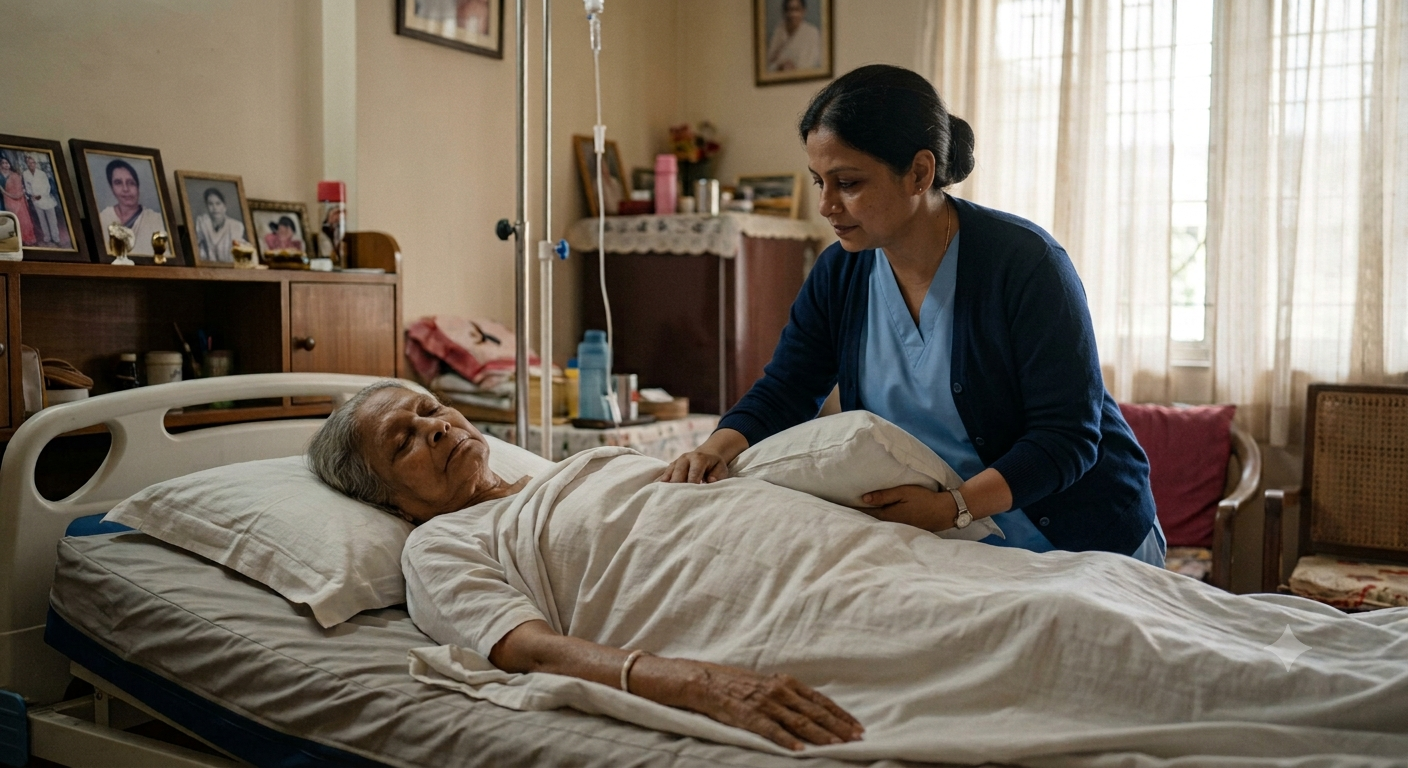
When a parent suddenly becomes bedridden — after a stroke, a major fracture, advanced Parkinson’s, or a long illness — the whole family’s routine changes overnight. In Kolkata, where most families still care for elderly parents at home rather than in a facility, adult children are often left googling at 11 p.m., trying to figure out how to turn a patient without hurting them, what causes bed sores, and whether they’re doing any of it right.
This guide walks you through exactly what bedridden patient care at home involves — positioning, hygiene, nutrition, movement, and the emotional side of it — and when it’s time to bring in a trained home nurse rather than trying to manage everything alone.
A patient is considered bedridden when they can no longer get out of bed on their own for daily activities — eating, using the washroom, or simply changing position. This can happen suddenly (after a stroke, a hip fracture, or major surgery) or gradually (as with advanced dementia, Parkinson’s disease, or terminal illness). Regardless of the cause, the care needs are similar: skin protection, hygiene, nutrition, gentle movement, and constant monitoring for complications.
Most families underestimate how physically and emotionally demanding this is until they’re living it. A bedridden patient needs to be repositioned every couple of hours, day and night, to prevent bed sores. Skin, hygiene, and toileting needs constant attention. Muscles weaken quickly without movement, raising the risk of blood clots and further decline. And because a family member is rarely trained in any of this, small mistakes — the wrong turning technique, a missed pressure point, a skipped meal — can lead to real medical complications like infected wounds or aspiration pneumonia.
On top of the physical demands, there’s the emotional weight of watching a parent lose independence, and the exhaustion of being “on call” around the clock. This is precisely the stage where many Kolkata families realise they need more than good intentions — they need trained hands.
Not sure if you can manage this alone? Talk to a trained home-care nurse today.
Book a Free Home Nursing Consultation
Or call us directly at +91 80622 55100
Before anything else, the patient’s room needs to be set up correctly:
Bed sores (pressure ulcers) are the single biggest risk for a bedridden patient, and they can develop within 24–48 hours of constant pressure on one spot — most commonly the heels, hips, lower back, elbows, and shoulder blades.
The basic rule: reposition the patient at least every 2 hours, alternating between their back and each side. Watch for these early warning signs at pressure points:
If you notice any of these, the turning schedule needs to become more frequent immediately, and the area should be kept clean and dry. A developing bed sore that’s ignored for even a few days can turn into a deep wound requiring medical treatment — this is one of the most common reasons Kolkata families end up calling a home nursing service in a panic.
Daily sponge baths, prompt changing of diapers or catheter care, and keeping bedsheets dry and wrinkle-free all directly reduce infection and skin-breakdown risk. Oral hygiene is often overlooked but matters just as much — a soft-bristle brush or mouth swabs, used at least twice a day, help prevent infections that can spread quickly in patients with weakened immunity. Nails should be kept short and clean, and any skin folds (underarms, groin) checked daily for moisture-related rashes.
Bedridden patients often eat less, which slows healing and weakens muscles further — a difficult cycle to break. Small, frequent, protein-rich meals work better than three large ones. If swallowing is difficult (common after a stroke), food should be soft, pureed, or thickened as advised by a doctor or speech therapist, since aspiration — food or liquid entering the lungs — is a serious risk. Hydration matters just as much as food; dehydration is one of the most common, and most preventable, causes of hospital readmission in bedridden elderly patients.
Even a patient who cannot get out of bed needs movement. Passive range-of-motion exercises — gently moving the arms, legs, and joints through their natural range — help prevent muscle atrophy, joint stiffness, and dangerous blood clots (deep vein thrombosis). This is an area where a trained physiotherapist makes a real difference: they know how much movement is safe, how to build it up gradually, and how to spot problems a family member would miss. Regular physiotherapy at home is one of the most under-used but effective parts of bedridden patient care in Kolkata.
It’s easy to focus entirely on the patient and forget that the family member providing round-the-clock care is also at risk — of exhaustion, sleep loss, and burnout. If you’re the primary caregiver, build in relief: rotate responsibilities with siblings where possible, and don’t hesitate to bring in professional respite support for even a few hours a day. Asking for help is not a failure — it’s what allows you to sustain good care over months, not just days.
Consider professional support if you notice any of the following:
None of these mean you’ve failed as a family — they simply mean the level of care your parent needs has moved beyond what’s safe to manage without training.
TribecaCare provides trained nurses, home-care attendants, and physiotherapists for bedridden and immobile patients across Kolkata — including bed-sore prevention and wound care, hygiene and personal care, feeding and swallowing support, and physiotherapy at home. Every care plan comes with transparent, itemised pricing, so families know exactly what they’re paying for before care begins. If you’re caring for a bedridden parent and aren’t sure where to start, call us at +91 80622 55100 for a free consultation — we’ll help you understand what level of care your parent actually needs.
At least every 2 hours, alternating between the back and each side, to prevent pressure sores. Patients at higher risk (very thin, diabetic, or already showing skin discolouration) may need repositioning even more frequently.
Skin that stays red or discoloured after pressure is removed, and skin that feels unusually warm, firm, or soft compared to the surrounding area. Left unaddressed, this can progress to blistering and open wounds within days.
Yes, with the right setup — a pressure-relieving mattress, a consistent turning and hygiene schedule, proper nutrition, and physiotherapy. Many families manage this successfully with support from a trained home nursing service, especially for the physically demanding parts of care.
Regular passive range-of-motion exercises, ideally guided by a physiotherapist, help maintain joint flexibility and reduce muscle atrophy and the risk of blood clots, even when the patient cannot move on their own.
If a bed sore develops, there are signs of infection, the patient has a wound, catheter, or feeding tube needing clinical care, or the family caregiver is reaching exhaustion — these are all clear signals that professional home nursing support is needed.