Care Guide
What to Do When Your Elderly Parent Is Living Alone in Kolkata

What to Do When Your Elderly Parent Is Living Alone in Kolkata

Tomar ma kemon aache? Is your mother alright? It is the question every Indian family fields from a worried relative every other week, and it is the question that gets harder to answer once a parent starts living alone in Kolkata.

A solo widow or widower in Kolkata is one of the most common situations Tribeca Care has seen across 12 years of operations. The fall, the missed medication, the day she stopped picking up the phone: by the time families notice, the warning signs have usually been visible for months. This guide covers what to look for, what daily care actually involves, and how to set up support whether you live in Salt Lake or somewhere across the world.

If your parent is in Kolkata and you are reading this in Jodhpur Park or somewhere overseas, the practical questions are the same. Who knows your parent by name? Who reaches them at 9am if they do not pick up? Who shows up at Apollo Gleneagles when there is a hospital admission? The rest of this guide is about answering those three questions concretely.

TC

Tribeca Care Editorial Team

Reviewed by Tribeca Care Medical Team  ·  Posted on May 6, 2026  ·  11 min read

Why Elderly Parents Living Alone Need Active Care

An elderly parent living alone in Kolkata is rarely lonely on day one. Loneliness arrives slowly. The cricket match nobody is around to discuss. The evening tea that becomes a single cup instead of two. The phone calls that get shorter because there is less to report. Most families notice none of this until something physical breaks the pattern, and by then the withdrawal has been quietly accumulating for months.

Loneliness is not a soft problem. The clinical evidence has been consistent across the last two decades: chronic loneliness in older adults raises the risk of cognitive decline, accelerates depression, and worsens recovery from every major illness. For elderly parents living alone, the risk compounds when the parent has recently been bereaved. The first 12 months after losing a spouse are the highest-risk period for the survivor, and the families who set up active care during the calm period have meaningfully better outcomes than the families who set it up after a crisis.

The two situations that drive most calls to Tribeca Care are the same across South Kolkata and Salt Lake. The first is a recent bereavement: the surviving spouse, often a woman in her seventies, suddenly alone in a flat that was built for two. The second is adult children who have settled in the US, the UK, or Singapore, and a parent who refuses to leave Bhowanipur. The right care set-up looks different in each case, but the starting question is the same. If something happens at 2am tonight, who does your parent actually call first?

If the honest answer is the building security guard, or the elderly neighbour two flats down, then there is a gap to close. Cognitive decline and dementia at home often becomes visible during this window, and so does depression that nobody named earlier because she sounds fine on the phone. Sounding fine is the most common false signal in this entire space.

Most families discover the loneliness only after a fall
By the time the fall happens, your parent has often been quietly withdrawing for months. Fewer phone calls. Less interest in food. Slower replies on WhatsApp. The warning signs are visible if you know what to look for. They are invisible if you assume "she sounds fine on the phone" means everything is fine.

How Tribeca Cares for an Elderly Parent Living Alone

Tribeca Care has been running active care for elderly parents living alone in Kolkata since 2013. The company was started by Prateep Sen in Kolkata and Tamojit Dutta in London. Prateep came back to Kolkata partly because of a recurring 3am thought about his own mother in her flat, alone, and the kind of help that did not exist in the form he needed. So they built it. Tribeca Care now operates across Kolkata with over five offices in the city, and the same operating questions still drive the model today.

What the model looks like in practice is simple to describe and harder to operate. Every member family has a named Care Manager, a real person who knows your parent by name, who visits on a fixed weekly schedule, and who is responsible for the relationship. Most members keep the same Care Manager for four years or more. Your Care Manager is reachable on WhatsApp between visits, so a worried call from a son in Boston or a daughter in Salt Lake gets a real person on the other end.

The operating components for a parent living alone are the daily check-in calls, the weekly home visits, the 24/7 emergency response, and a full set of medical services delivered at home. The check-in calls happen at 9am and 6pm. The weekly home visit is on a fixed day, the same day each week, because routine is what makes the relationship feel real to a parent who lives alone. Most routine medical care for a parent living alone can also happen at home, which spares your parent the stress of travelling to hospitals for non-urgent visits.

When something happens, our emergency line is answered by a human at every hour. For the families who do not live in Kolkata, the same Care Manager who visited yesterday is the one who reaches the hospital tonight. Continuity matters because hospital admissions are the moment when families farthest away need someone they trust on the ground.

You can hear how this lands in our Google reviews. Tribeca Care has more reviews than every other senior care service in Kolkata put together, and the reviews talk less about features than about how a Care Manager picked up the phone at the right moment.

Plans for elderly parents living alone start at ₹2,000 per month for emergency-only response, and go up to ₹10,000 per month for high-touch clinical care. For most solo seniors, the Suraksha plan at ₹3,000 per month is the right fit, because emergency-only does not retain bereaved spouses well, and high-touch is built for parents with named clinical conditions. Elder care services in Kolkata covers the full service map. Compare Tribeca elder care plans walks through pricing and what is included.
The four operating components of daily care

  • Daily check-in calls. Morning call confirms your parent is up, has had breakfast, and is feeling well. Evening call confirms the day went without incident.
  • Weekly home visits. On a fixed day each week (Monday morning for one member, Thursday evening for another), the Care Manager visits in person. Vitals checked, medications counted, fridge inspected, mood read. Your Care Manager is reachable on WhatsApp between visits, so a worried family member at any timezone can get a real person on the other end.
  • Medical services at home. Doctor home visits, nursing care, physiotherapy, blood draws, IV setup, supervised medication management, and home vaccinations including the annual flu and pneumonia shots. Most routine medical care for a parent living alone can happen at home, which avoids the stress of travelling to hospitals for non-urgent visits.
  • 24/7 emergency response. Our emergency line is answered by a human, every hour, every day. For Suraksha and above, the Care Manager who knows your parent by name is the one who reaches the hospital.
  • Hospital coordination. When your parent is admitted to Apollo Gleneagles, Woodlands, or AMRI Salt Lake, a Tribeca team member coordinates with the treating team, talks the family through what is happening, and stays through the discharge planning. Daily home health care visits continue through the recovery.

Warning signs that a parent living alone needs more support

  • Phone calls get shorter. A parent who used to spend twenty minutes on the phone now closes the call in five. The reasons given are usually plausible (the maid is at the door, the cook is asking something) but the pattern is what matters.
  • Food intake drops. The fridge has the same things in it across two of your visits. The cook reports your mother is eating less. Weight loss in an older parent is rarely a diet, it is a symptom.
  • Medication confusion. Your father skipped his evening BP tablet twice last week. He says he forgot. Forgetting is sometimes forgetting. It is also sometimes the first observable sign of something else.
  • Withdrawal from regulars. The neighbour she always met at the market. The pujo committee meeting she always attended. The cousin she always called on Sundays. When the regular contacts drop one by one, isolation is taking shape.
  • Sleeping pattern shifts. Up at 3am, asleep at 11am, daytime drowsiness that was not there a year ago. Disrupted sleep in older adults is a leading early indicator of cognitive change and depression both.
  • The “I am fine” reflex hardens. Every honest worry is met with the same answer. When a parent who used to share things stops sharing, the silence is data.
Your parent does not need to be in crisis to need this

The right time to set up active care is before the next fall, before the next hospital admission, before the next bout of withdrawal. Families who set up Tribeca during the calm period have a better experience and lower long-term costs than families who set it up during a crisis. The calmest day to make this decision is today.

The right Tribeca plan for an elderly parent living alone

The plan that fits a parent living alone depends on three things: whether they have a named clinical condition, whether they were recently widowed, and how often you (the adult child) can be physically present in Kolkata. The four scenarios below cover roughly 90 percent of the families who reach out to us.

Solo widow or widower in Kolkata

Recommend Suraksha at ₹3,000 per month. Two Care Manager home visits and six calls a month, plus 24/7 emergency response. The frequency is what makes the relationship real, which matters more for a solo widow than for a couple still together. Our 12-year retention data shows solo widows on emergency-only plans drop off within two years; on Suraksha they stay because the Care Manager becomes a trusted figure.

Solo with a named clinical condition

Parkinson's, dementia, dialysis, post-stroke, cancer in treatment. Recommend Aador or Jotno. Clinical complexity needs more than emergency-only. Aador adds doctor coordination, supervised medication management, and home nursing visits. The cost is higher (₹6,000 to ₹10,000 per month range), but the alternative is the family member abroad managing medications over WhatsApp.

Solo and recently bereaved

Suraksha at minimum, with the Tribeca bereavement protocol activated. The first 12 months after losing a spouse are the highest-risk window for the survivor across every health metric. The bereavement protocol adds extra check-in calls in the first 90 days, a wellness review at month three and month six, and proactive enrolment in Club Tribeca senior community events to rebuild routine.

Solo, fit, and supported by family abroad

Suraksha or Jotno depending on how present family is locally. The premium tier is built for clinical complexity rather than for a particular kind of family, but it suits families managing care across timezones because the Care Manager answers WhatsApp in your window, and updates from visits arrive while you are still at your desk. Distance does not have to mean uncertainty.

Distance does not have to mean uncertainty

Daily support: what a typical week looks like

The honest answer to “what does daily care actually look like” is more boring than most families expect, and that is the point. The week is built on routine, because routine is what catches the small changes before they become big ones. A parent who skips breakfast on Tuesday is one data point; a parent who has skipped breakfast on three Tuesdays in a row is a pattern that gets escalated.

A typical week for a Tribeca-supported parent in Ballygunge or New Alipore looks roughly like the schedule below. Specific timings vary by family preference, but the rhythm is the same across plans.

A typical week for a parent living alone on a Tribeca plan

☑ Tick what applies to your parent's home. Then screenshot this list and send it to a sibling or caregiver - it's easier to fix things when everyone sees the same gaps.

Daily check-in call from the Care Manager

Daily WhatsApp message confirming the day went well

Weekly home visit on a fixed day of the week, same day every week

Monthly visit by the supervising doctor for plans Aador and above

Quarterly health check at home with BP, sugar, and basic vitals recorded

Annual flu and pneumonia vaccinations via home vaccinations for seniors

Club Tribeca events for members including chai adda, Pujo and Poila Boishakh celebrations, and member day-trips

When your parent is in Kolkata and you are abroad

Many of the families planning care for an aging parent in Kolkata are doing it from the US, the UK, Singapore, or Australia. The pattern of needs is consistent across timezones. The hardest hour is not the emergency at 3am Kolkata time. It is the Sunday morning when you have not heard from your mother since Friday and the WhatsApp double-tick is still grey.

The way Tribeca handles this is procedural rather than emotional. Your Care Manager is reachable on WhatsApp every day, in your timezone-aware window, so when you have the question you can ask it and get a real answer back. You can ask for a video call any time. Billing accepts foreign currency, and your parent’s care is documented in a way you can share with your spouse, your sibling in Bangalore, or your father’s cardiologist in Boston.

The honest measure of whether this is working is whether you sleep better at night, not whether you receive more notifications. The families who do this well are the ones who set up the relationship during a calm period (a December visit home, a planned trip in March), not the families who try to set it up during the panic of a hospital admission. Elder care for parents whose children live abroad walks through the full process for families managing care from outside India.

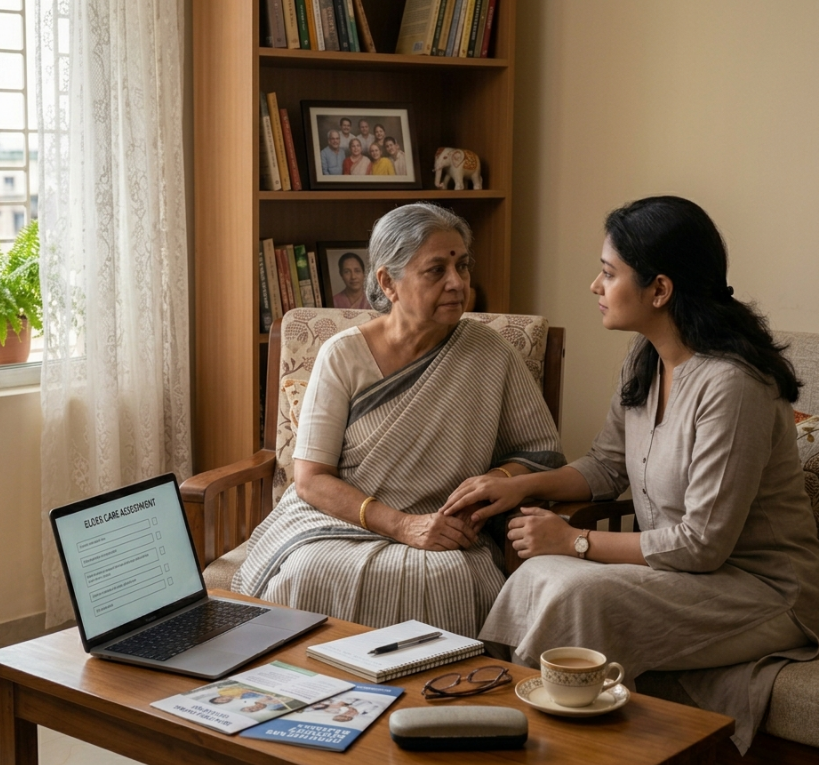
Free 30-minute care assessment for your parent

If you would like, we can help you think through what your parent’s situation actually needs. The first conversation is a 30-minute call with one of our Care Advisors. We learn about your parent, listen to the worry, and recommend a plan that fits. No obligation.

The assessment that follows is always in person, at your parent’s home, on a day that suits the family. If you are in Kolkata, you can be present for the visit. If you are managing care from abroad, you can join over video call to be on the visit live, and your Care Advisor is reachable on WhatsApp afterwards to talk through what we saw.

What happens next:
  • A Care Advisor reaches out within 24 hours, by WhatsApp or phone
  • 30-minute call to understand your parent’s situation and your worry
  • Plan recommendation, sent in writing for you to share with siblings
  • If you decide to proceed, in-person home visit at your parent’s home, on a day that suits the family
  • If you do not proceed, no follow-up sales calls. We will check in once at the 3-month mark
✓ This is not an emergency service and not a sales call. If the situation appears low-risk, you'll be told that plainly. You decide what, if anything, to do next. You can opt out at any time.

Need a professional home safety assessment?

Our team can assess your parent's home environment room by room, identify structural risks a checklist won't catch, and create a prioritised safety plan - starting at ₹999.

Book a Home Risk Audit

The right time to set up active care for a parent living alone is before the next fall, not after.